
Over 300,000 Cocker Spaniels are registered in the UK, and alongside their Springer cousins, they consistently dominate the list of our nation’s favourite breeds. We understand the initial draw to these merry gundogs, but we also know the reality of living with a working-line Spaniel that seems to have no “off-switch.” We have spent over 15 years in the field and the living room, watching owners walk their dogs for four hours a day only to come home to a Springer that is still bouncing off the walls or a Cocker that has shredded the sofa cushions in a fit of anxiety. It is a common struggle that often leads to a cycle of exhaustion for both the human and the hound.
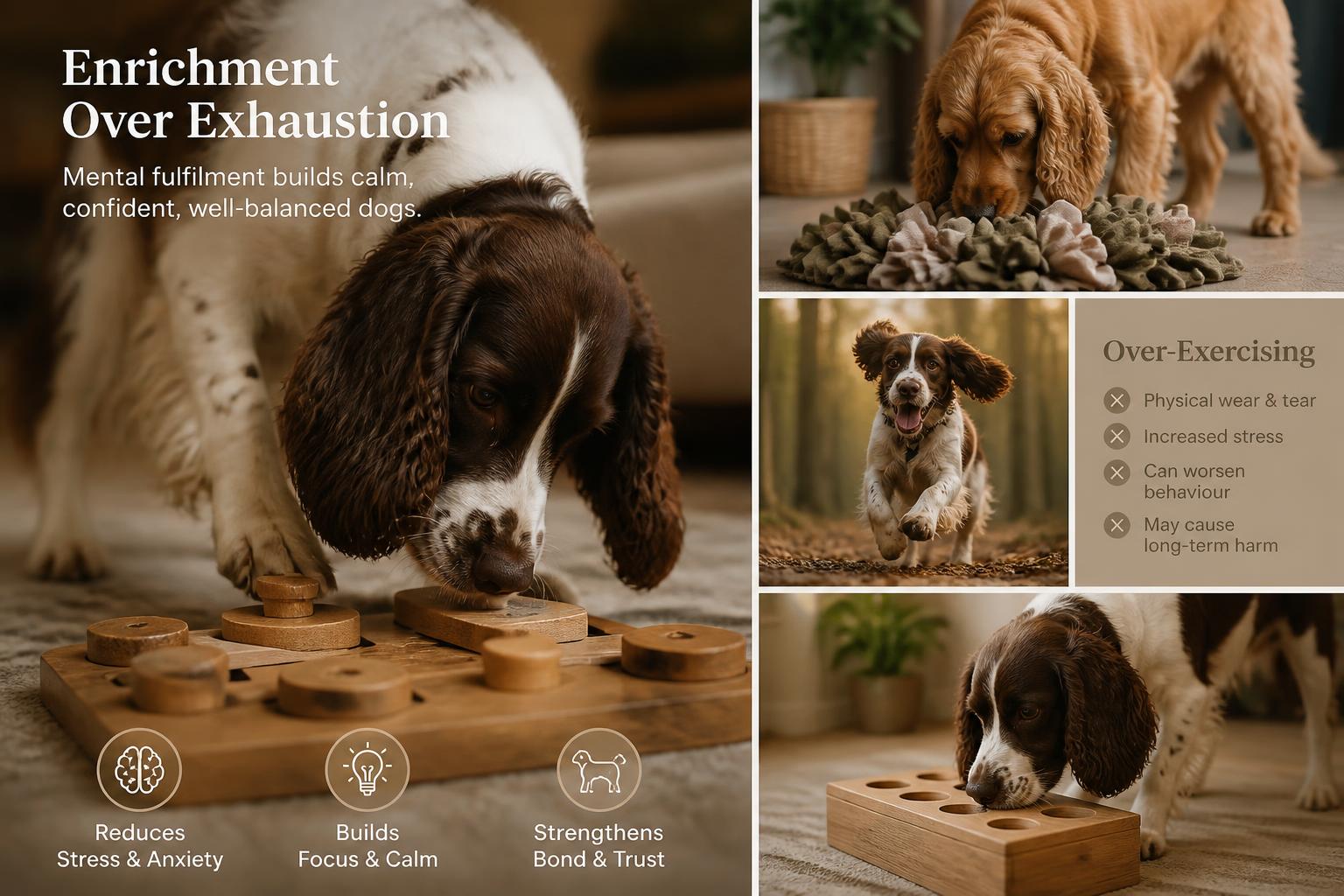
We recognise the frustration when traditional advice fails to produce a settled pet. Many owners believe that more physical exercise is the only way to tire out a high-energy dog, yet we see that this often has the opposite effect. In working-line breeds, constant high-intensity activity like ball-chasing actually spikes cortisol levels, keeping the dog in a state of “fight or flight” long after the walk has ended.
Recent data suggests that 70% of dog owners report anxiety in their pets, and in our experience, much of this stems from a lack of appropriate mental outlets rather than a lack of miles on the clock. We are here to tell you that you cannot outrun a Spaniel’s stamina, but you can certainly outsmart it.
“The secret to a calm Spaniel isn’t found in the length of the lead, but in the engagement of the brain; mental stimulation can reduce cortisol by up to 30%.”
– UK Veterinary Behavioural Study, 2022
Our approach shifts the focus from physical exhaustion to what we call “top-down tiredness.” By strategically engaging the powerful gundog instincts that are hard-wired into every Spaniel, we can create a sense of true contentment that physical running simply cannot match. We have seen firsthand how five minutes of nose work or a focused licking activity can be more taxing than a three-mile sprint across a muddy field. This guide serves as our definitive “Settling Blueprint,” designed to help you navigate the transition from a frantic household to a peaceful one where your dog knows how to relax.
We will guide you through seven specific pillars of enrichment that address the root causes of hyperactivity and destructive habits. You will learn how to turn mealtime into a brain teaser, why the “sniffari” is the most important walk you will ever take, and how to use natural chews to soothe a worried mind. We also place a heavy emphasis on building a safe haven within the home, ensuring your Spaniel learns the vital skill of switching off. This is not about complex training drills; it is about cooperative living that respects the Spaniel’s heritage while making them a joy to have in a modern UK home.
A settled Spaniel is a happy Spaniel, and a happy owner. We have lived through the “crazy” stages ourselves and emerged on the other side with dogs that are as calm in the kitchen as they are keen in the field. By following these evidence-based steps, we will help you harness that famous Spaniel energy and transform it into focused, quiet confidence. Let us begin by looking at why your current exercise routine might be part of the problem, and how we can start lowering those stress hormones today.
We understand the relentless drive of a working-line Cocker or Springer; their internal engines often feel as though they lack an off-switch. We have all faced the exhaustion of throwing a tennis ball for hours, only to find our Spaniels bouncing off the kitchen walls moments after returning home. This frustrating cycle occurs because we are inadvertently building elite athletes with soaring cortisol levels rather than calm companions.
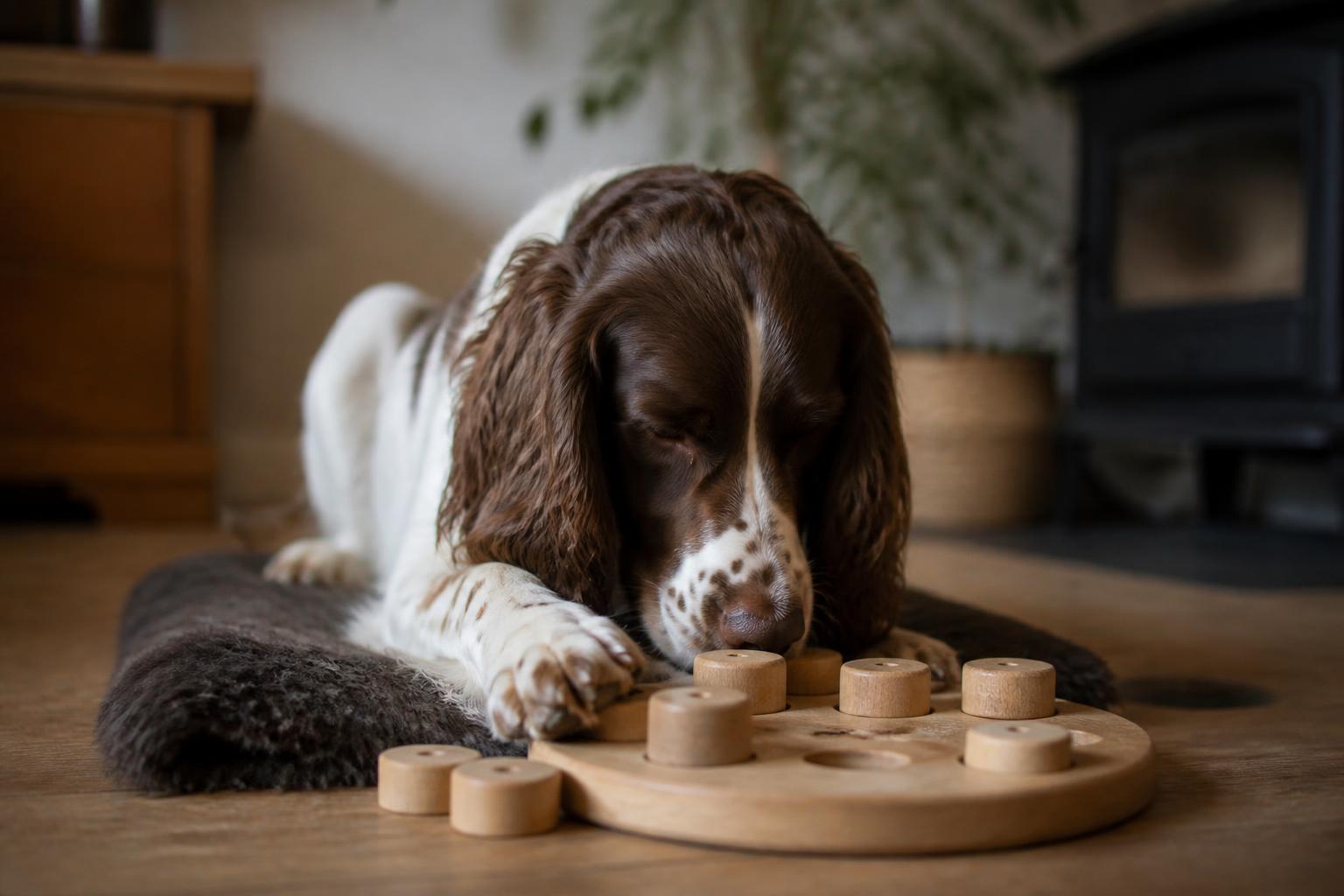
We know the challenge of realizing that traditional exercise often fuels the fire of hyperactivity instead of extinguishing it. By shifting our focus toward the biological “Cortisol Conundrum,” we can finally move away from mindless physical exertion.
We are here to introduce the vital concept of Top-Down Tiredness, a method designed to drain that frantic energy by engaging the brain first, ensuring our gundogs find the true settle they deserve.
The Cortisol Conundrum from Constant Play
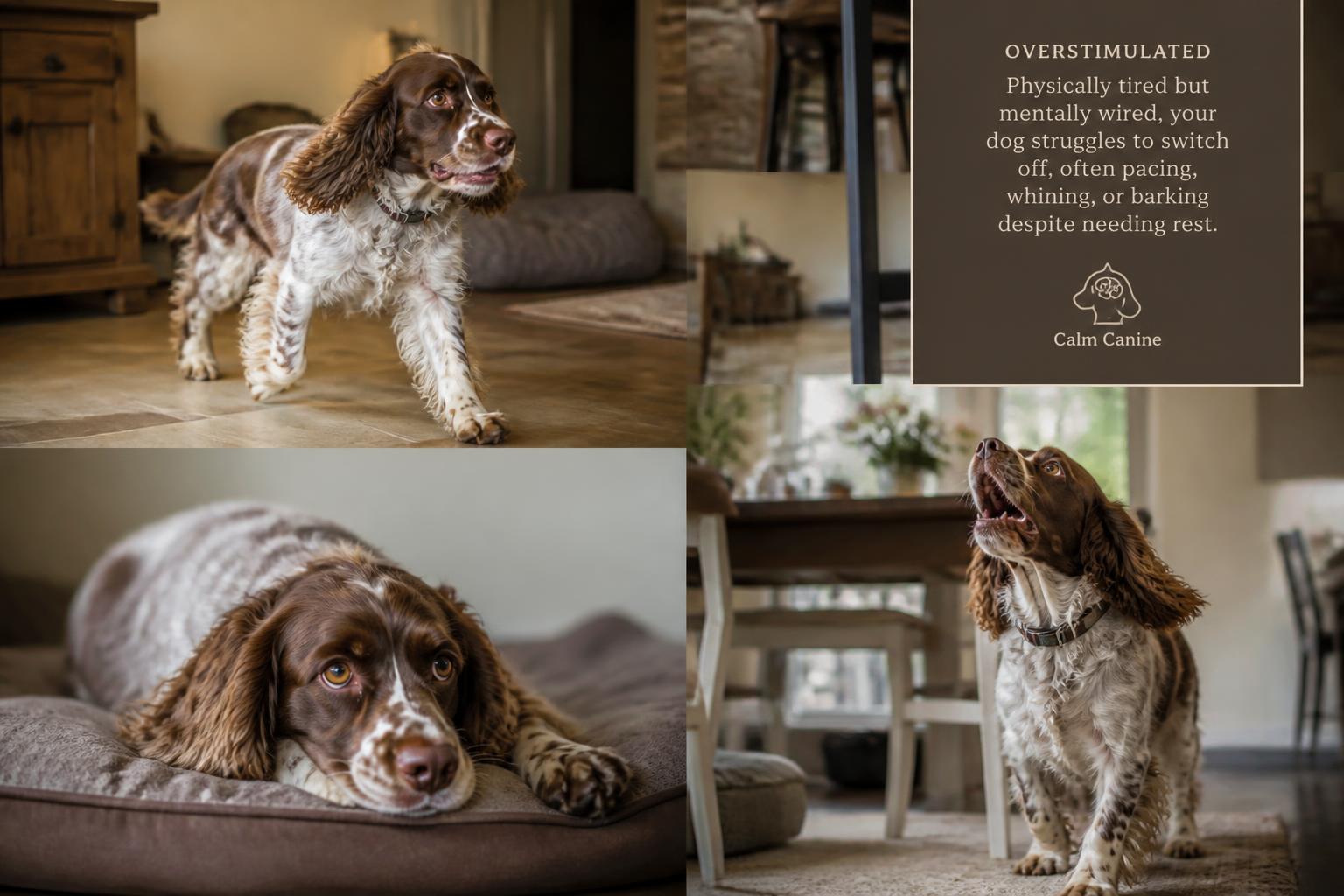
We have all been there: standing in a damp British field, arm aching from the plastic ball flinger, watching our Spaniel sprint with a frantic, glazed expression. It feels like the right thing to do because we believe that a tired dog is a good dog. However, we often find that after an hour of high-intensity fetching, our Springers and Cockers aren’t actually resting; they are pacing the kitchen, unable to settle, or barking at every leaf that brushes the window. We are witnessing the cortisol conundrum, where the very exercise intended to drain energy is actually fueling a state of chronic stress.
When we engage a Spaniel in repetitive chase games, we aren’t just building their cardiovascular fitness; we are flooding their system with adrenaline and cortisol. While these hormones are essential for the “fight or flight” response, they are not designed to be triggered repeatedly for forty minutes straight. According to research by Dr.
Karen Overall, a leading authority on canine behaviour, these chemical spikes fundamentally alter a dog’s ability to regulate their emotions. We see this most clearly in working-line Spaniels, who were bred for sustained, high-intensity activity, but were never intended to perform high-speed retrieves on a loop without a functional purpose.
Repetitive retrieve games increase cortisol by up to 60% post-exercise. This is a staggering figure when we consider that this hormone does not simply vanish once the ball is put away. In fact, cortisol takes 24-48 hours to return to baseline levels after a significant spike. If we take our Spaniel out for a “crazy” ball session every afternoon, we are essentially keeping them in a permanent state of physiological arousal. Their nervous system never gets the chance to reset, leading to a dog that is “wired but tired”-physically exhausted but mentally incapable of reaching a deep, restorative sleep.
“The repetitive nature of fetch creates a cycle of addiction to arousal. We think we are exercising the dog, but we are often just training them to be an athlete with no off-switch.”
– UK Veterinary Behaviourist Observation, 2023
We must understand the difference between physical fatigue and mental fatigue. A Spaniel who has run five miles after a ball has tired muscles, but their brain is still vibrating at a high frequency. Conversely, a dog that has spent twenty minutes solving a complex problem or navigating a difficult scent trail experiences a drop in blood pressure and a rise in “feel-good” neurotransmitters.
We have found that relying solely on physical exertion actually builds a dog’s stamina, meaning we have to throw the ball longer and further every single week just to reach the same level of tiredness. It is a race we, as owners, will never win.
The long-term impact on a Spaniel’s nervous system can be profound. When a dog lives in a state of high cortisol, they become “reactive” rather than “responsive.” This means they are more likely to jump at small noises, struggle with separation, or display destructive chewing habits. We aren’t just dealing with a “naughty” dog; we are dealing with a dog whose internal chemistry is out of balance. UK veterinary behaviourists now increasingly advocate for balanced stimulation that prioritises the parasympathetic nervous system-the part of the brain responsible for “rest and digest”-rather than the sympathetic nervous system which governs high-arousal play.
To help our Spaniels find their internal “off-switch,” we need to move away from the frantic energy of the chase and toward activities that satisfy their gundog soul without breaking their brain. We need to look at how we can drain that incredible Spaniel battery from the inside out, using the very instincts they were bred for. This shift in perspective is the first step toward a home where the sight of a sleeping Spaniel isn’t a rare miracle, but a daily reality. The question then becomes how we actually trigger that relaxation response through their natural biology.
Introducing Top-Down Tiredness for UK Spaniels
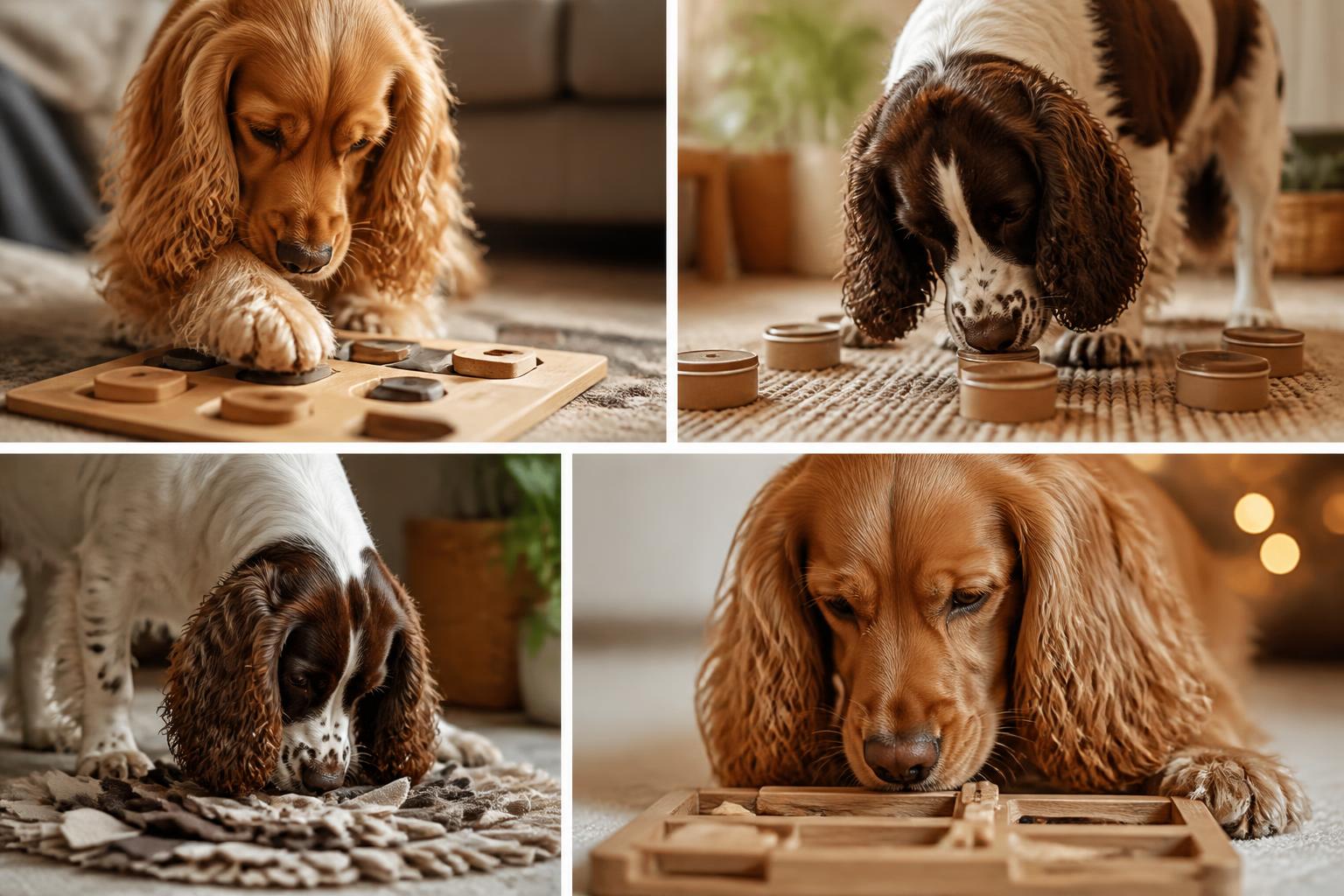
Focusing on the brain rather than the paws changes the entire recovery trajectory for a hyperactive Springer or Cocker. When we stop trying to outrun a dog bred for endurance and start outsmarting them, we tap into a biological shortcut to relaxation. This shift in strategy is what we call top-down tiredness, a method that prioritises cognitive fatigue to trigger a natural “off-switch” in the canine nervous system.
We have found that mental stimulation is significantly more taxing than physical exertion alone. In fact, mental work burns calories at a rate of two to three times that of physical exercise for the same duration of effort. This is why a Spaniel might return from a five-mile hike ready to play, yet collapse into a deep sleep after a short session of complex problem-solving. We aren’t just looking for a tired dog; we are looking for a satisfied dog whose predatory drive has been professionally channelled.
The RSPCA UK actively promotes cognitive enrichment as a cornerstone of animal welfare, specifically to prevent the boredom-induced “zoomies” that plague many working-line households. By giving our Spaniels a “job” to do-even if that job is simply deciphering a puzzle in the kitchen-we satisfy the ancestral urge to hunt and forage. Studies show that providing these opportunities for problem-solving can reduce destructive behaviours, such as sofa-chewing or excessive barking, by up to 40%.
“True exhaustion in a working breed isn’t found in the legs; it’s found in the processing power of the brain. When a Spaniel uses its mind to solve a puzzle, the resulting calm is profound and lasting.”
– Senior Field Trial Trainer, UK Gundog Association
One of the most accessible ways we implement this is through the power of the nose. Sniffing for just 15 minutes is biologically equivalent to a 60-minute brisk walk in terms of the mental fatigue it generates. This is because the olfactory bulb in a Spaniel is highly developed, requiring immense concentration to categorise and track scents. When we allow them to use this “gundog hardware,” we are essentially running a high-intensity workout for their brain while their body remains in a low-arousal state.
Understanding the difference between being physically “drained” and mentally “content” is vital for any owner struggling with a reactive or anxious pet. Physical fatigue often leaves a dog with a racing heart and high adrenaline, whereas cognitive enrichment encourages the parasympathetic nervous system to take over. This leads to a genuine state of rest, where the dog isn’t just waiting for the next ball throw, but is truly ready to switch off and decompress.
To help you visualise how to balance your Spaniel’s daily routine, we have compared the impact of traditional “chase” exercise versus mental enrichment activities below:
| Activity Type | Primary Impact | Recovery Time | Caloric Brain Burn |
|---|---|---|---|
| High-Intensity Fetch | Physical / Adrenaline | 24–48 Hours | Low |
| Scent Work / Puzzles | Mental / Cognitive | Immediate Calm | High (2-3x) |
| Standard Road Walk | Physical / Routine | Short-term | Moderate |
| 15-Min Sniffari | Mental / Sensory | Deep Sleep | Very High |
We know the frustration of watching a dog pace the floor after a long afternoon in the fields, but this is usually a sign that their mind is still “hunting” even if their legs are heavy. By introducing structured mental tasks, we bridge that gap. We move away from the cycle of overstimulation and toward a household where the dog understands how to settle independently.
This cognitive approach doesn’t just stop at games; it extends to the very way our Spaniels soothe themselves during moments of high pressure. While we have focused on “working” the brain to achieve quiet, there are also passive biological triggers that can lower a dog’s heart rate almost instantly. These natural calming mechanisms are often hidden in plain sight, waiting to be used as tools for deep emotional regulation.
We know the frantic energy of a Springer or Cocker all too well; that restless pacing and demanding nudge for attention often stem from a brain that simply cannot find its “off” switch. Through our decades of working with these driven gundogs, we have discovered that the most direct route to a settled household isn’t another mile of road walking, but rather tapping into the biological soothing power of the tongue and jaw. We understand the science behind how repetitive licking and focused chewing trigger a flood of calming endorphins, effectively lowering cortisol levels and melting away the hyper-vigilance that plagues many working-line pets.
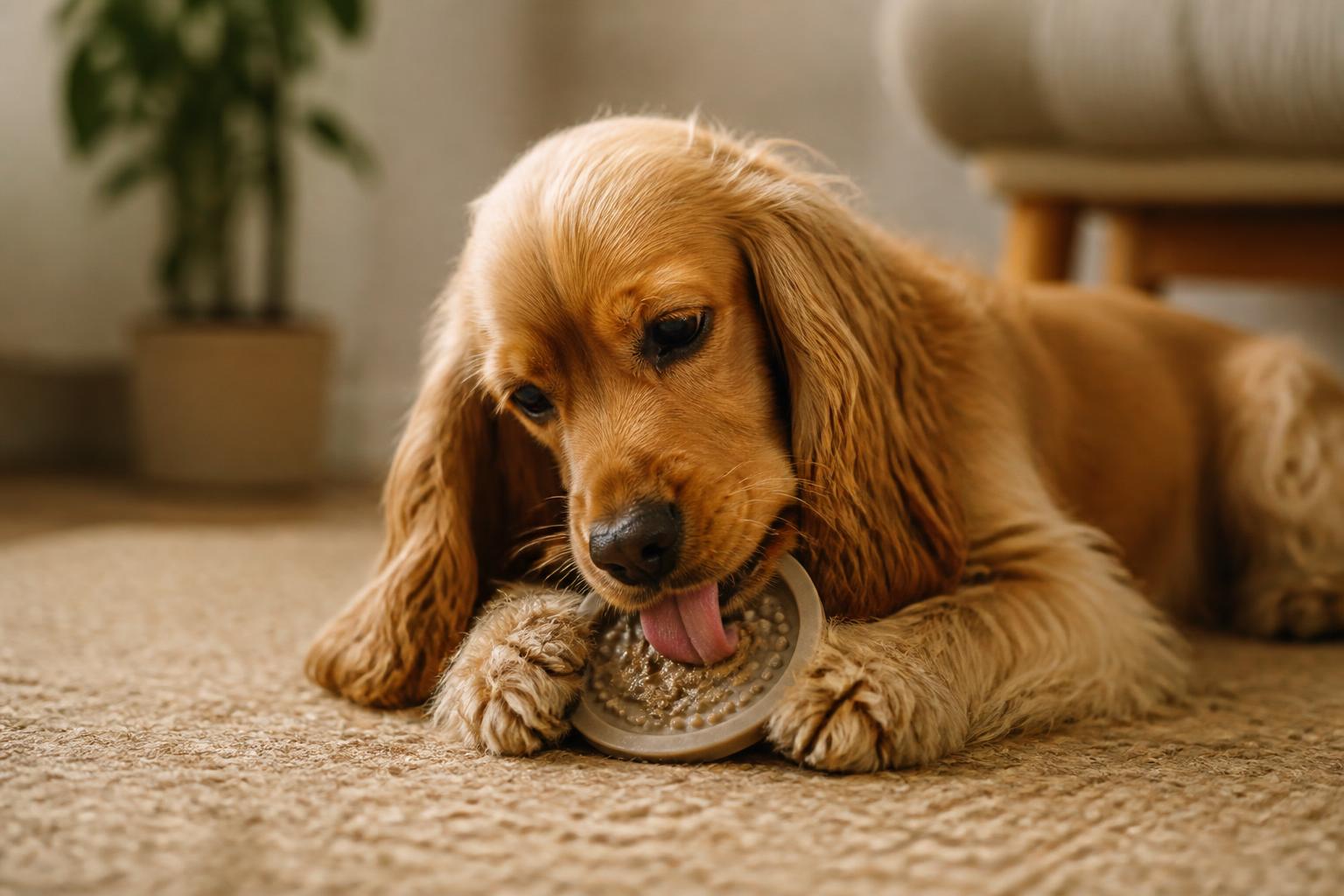
By mastering the strategic use of UK favourites like stuffable Kongs and lick mats, we can transform a vibrating ball of Spaniel energy into a blissfully quiet companion, providing them with the vital mental decompression they crave.
The Endorphin Release from Repetitive Licking
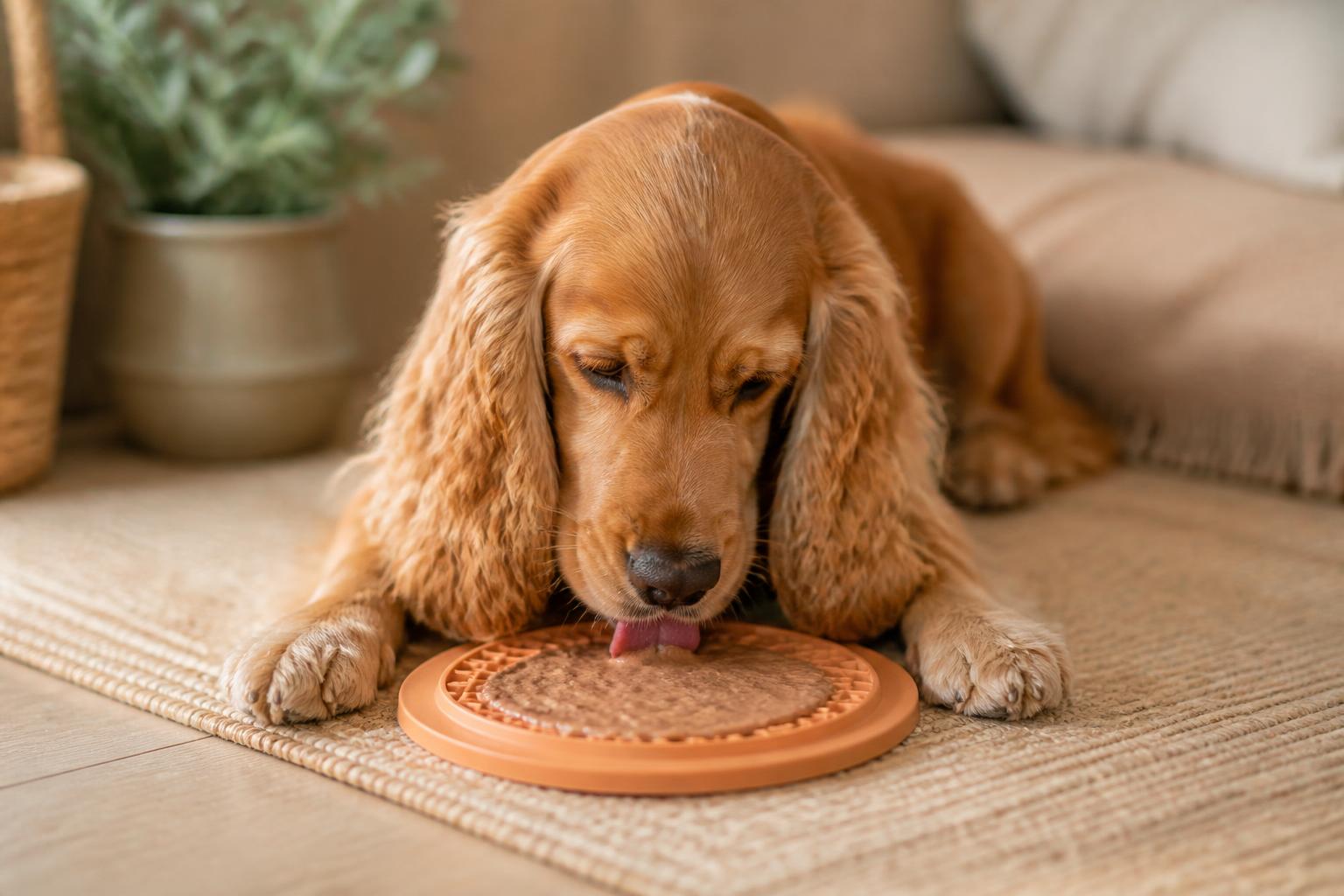
While a high-speed chase across a paddock might look like the peak of Spaniel joy, it often leaves their internal systems screaming at a high frequency. We have found that the most profound shifts in a dog’s emotional state don’t happen during the sprint, but rather in the quiet moments of repetitive licking. This isn’t just a quirky habit; it is a sophisticated biological reset button that leverages the dog’s own neurochemistry to override the “always-on” gundog brain.
The science behind this is fascinatingly simple. When a Spaniel engages in rhythmic licking, they stimulate the vagus nerve, a major component of the nervous system that acts as a direct line to the brain’s calming centres. We know from clinical observations that this specific action can reduce a dog’s heart rate by 10-15 beats per minute (bpm) almost immediately. It is the canine equivalent of deep-breathing exercises, forcing the body to transition from a state of high alert to one of physiological rest.
85% of dogs show a measurable reduction in anxiety during licking activities. This isn’t a coincidence; the act of licking triggers the brain to flood the system with endorphins. These internal chemicals serve as natural pain relievers and potent mood elevators, creating a sense of euphoria that effectively “mops up” the residual stress hormones left over from a busy day in the field or a stressful encounter with a delivery van.
“Licking is a natural self-soothing behaviour that dogs use to regulate their own emotional state. By providing structured opportunities for this, we are giving them a functional tool to manage the pressures of a modern domestic environment.”
– Dr. Sarah Heath, UK Veterinary Behaviourist
We often see the most dramatic results when we time these activities strategically. For a working-line Springer or Cocker, the transition from a high-arousal walk to the stillness of the living room can be jarring. Introducing a lick-based task during these “bridge” moments-or during known stressors like thunderstorms and fireworks-provides a productive outlet for their energy. Instead of pacing or whining, the dog focuses entirely on the neurochemical reward of the task, which naturally lowers their blood pressure and settles their mind.
To get the most out of this biological trigger, we recommend the following approaches to maximise the duration of the soothing effect:
- Texture Variety: Use different surfaces to keep the tongue engaged and the sensory input high.
- Temperature Control: Freezing your enrichment tools can extend the licking activity by up to 300%, turning a five-minute snack into a twenty-minute deep-relaxation session.
- High-Value Pastes: Use sticky, healthy fats like xylitol-free peanut butter or plain Greek yogurt that require significant effort to remove.
- Consistency: Offer the activity in the same “safe zone,” such as a bed or crate, to build a strong association between licking and relaxation.
It is important to distinguish this from “boredom licking” at their own paws, which can be a sign of distress or allergy. Structured licking is about providing an external target that requires focus and physical effort. When a Spaniel is working a surface for every last molecule of food, they aren’t just eating; they are performing a “job” that satisfies their ancestral need to forage while simultaneously bathing their brain in calming chemicals.
We have seen firsthand how a “wired” Spaniel, unable to settle after a training session, can be transformed by ten minutes of focused licking. It is the most effective way to bridge the gap between the field and the sofa. The challenge for most owners isn’t understanding the science, but rather choosing the right equipment to deliver these benefits without making a mess of the carpet.
UK Favourites: Lick Mats and Stuffable Kongs
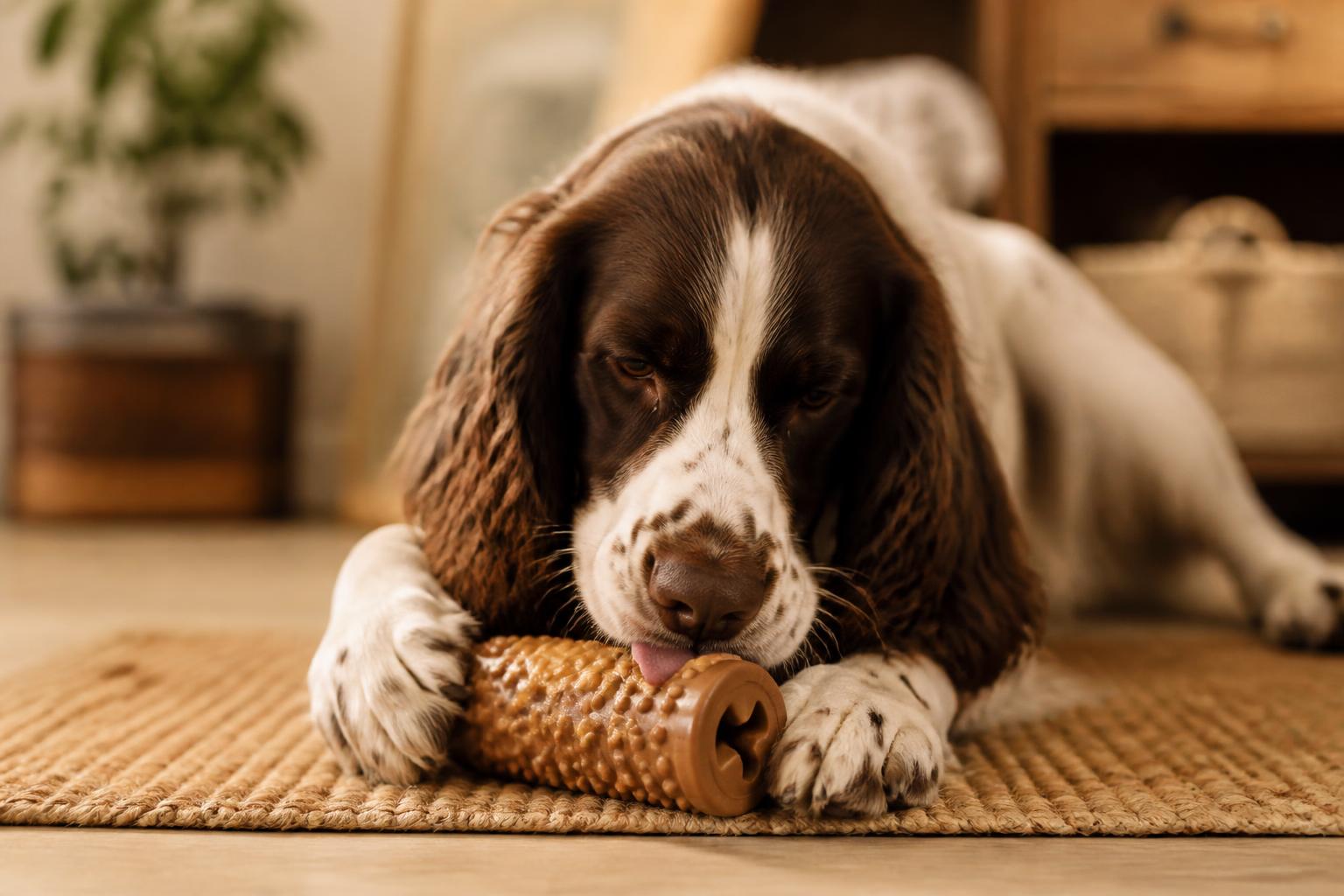
We have transitioned from viewing licking as a mere habit to respecting it as a biological necessity for the working Spaniel. While we understand the internal chemistry at play, the practical challenge for most owners is choosing the right tools from a market saturated with plastic gadgets. In our experience training high-drive Springers and Cockers, the Kong Classic remains the gold standard for durability; its unique shape and tiered internal rings are specifically designed to make the “hunt” for food more challenging for a determined gundog mouth.
For those just starting their enrichment journey, we often recommend the Lickimat Buddy, which is widely available at UK retailers like Pets at Home or Jollyes. Its cross-maze design is perfect for holding thick pastes, forcing your Spaniel to use the tip of their tongue to navigate the grooves. We find that beginners often overcomplicate the fillings, but the most effective options are often already in your kitchen cupboards, such as mashed banana or plain, unsweetened yoghurt.
Mastering the Art of the Stuffable Toy
The secret to a settled Spaniel isn’t just what you put inside the toy, but how you layer it to maintain their focus without causing frustration. We suggest a “plug and play” approach: start with a few small biscuit treats at the bottom of a Kong to provide an immediate reward, then pack in a dense base like Forthglade or Lily’s Kitchen wet dog food. This creates a varied texture that keeps their brain engaged as they work through different levels of difficulty.
Freezing a stuffed Kong can extend engagement from 15 minutes to over an hour. This is our preferred method for managing those “witching hour” moments when a Spaniel’s energy peaks in the evening. By turning the soft filling into a solid block, you force the dog to work much harder, effectively doubling the cognitive load. We suggest keeping at least two of these ready in the freezer at all times so you are never caught out by a sudden burst of hyperactivity.
| Filling Type | Best For | Trainer’s Tip |
|---|---|---|
| Xylitol-free Peanut Butter | High-value distraction | Use sparingly due to high calorie count. |
| Mashed Banana | Easy spreading | Perfect for freezing into Lickimats. |
| Wet Food (e.g., Forthglade) | Complete meal replacement | Pack tightly to increase the challenge. |
| Plain Greek Yoghurt | Low-calorie soothing | Great for a quick afternoon “reset.” |
Introducing Enrichment to a Novice Spaniel
If your Spaniel has never worked for their food before, don’t expect them to solve a frozen puzzle immediately. We have seen many owners make the mistake of making the task too hard on day one, leading the dog to simply give up and walk away. Start with loose kibble or a very thin layer of xylitol-free peanut butter that is easy to remove; once they understand the “licking equals reward” concept, you can gradually increase the difficulty by packing the contents tighter or introducing the freezer.
Safety is paramount, especially with the powerful jaws of a working-line dog. We always advise supervising your Spaniel during their first few sessions with any new rubber toy or mat to ensure they aren’t attempting to chew chunks off the silicone. While these tools are robust, a bored or frustrated Spaniel can be surprisingly destructive if they feel they can’t reach the food inside. If they start gnawing the edges of a Lickimat, it is a clear sign they need a simpler task or a more durable rubber toy like a Kong Extreme.
While these tools are fantastic for calming the mind through the mouth, they only address one part of the Spaniel’s ancestral toolkit. Even a dog that has spent an hour licking a mat still possesses an incredible, unused superpower: an olfactory system that is constantly scanning the environment for information. This leads us to consider how we can move beyond the kitchen and start putting that legendary gundog nose to work in ways that provide even deeper mental decompression.
We know the challenge of a wet Tuesday in the UK when the rain is horizontal and your working-line Springer is vibrating with untapped energy. While a long walk isn’t always feasible, a Spaniel’s nose never clocks off, and we have found that engaging their natural gundog instincts indoors is the most effective way to achieve that elusive “top-down tiredness.” We understand that an under-stimulated nose often leads to a destructive mouth, which is why we prioritise scent work as a non-negotiable “job” for your dog. By repurposing your living room into a search arena, we can help you lower your dog’s cortisol levels and build their confidence through cooperative play.
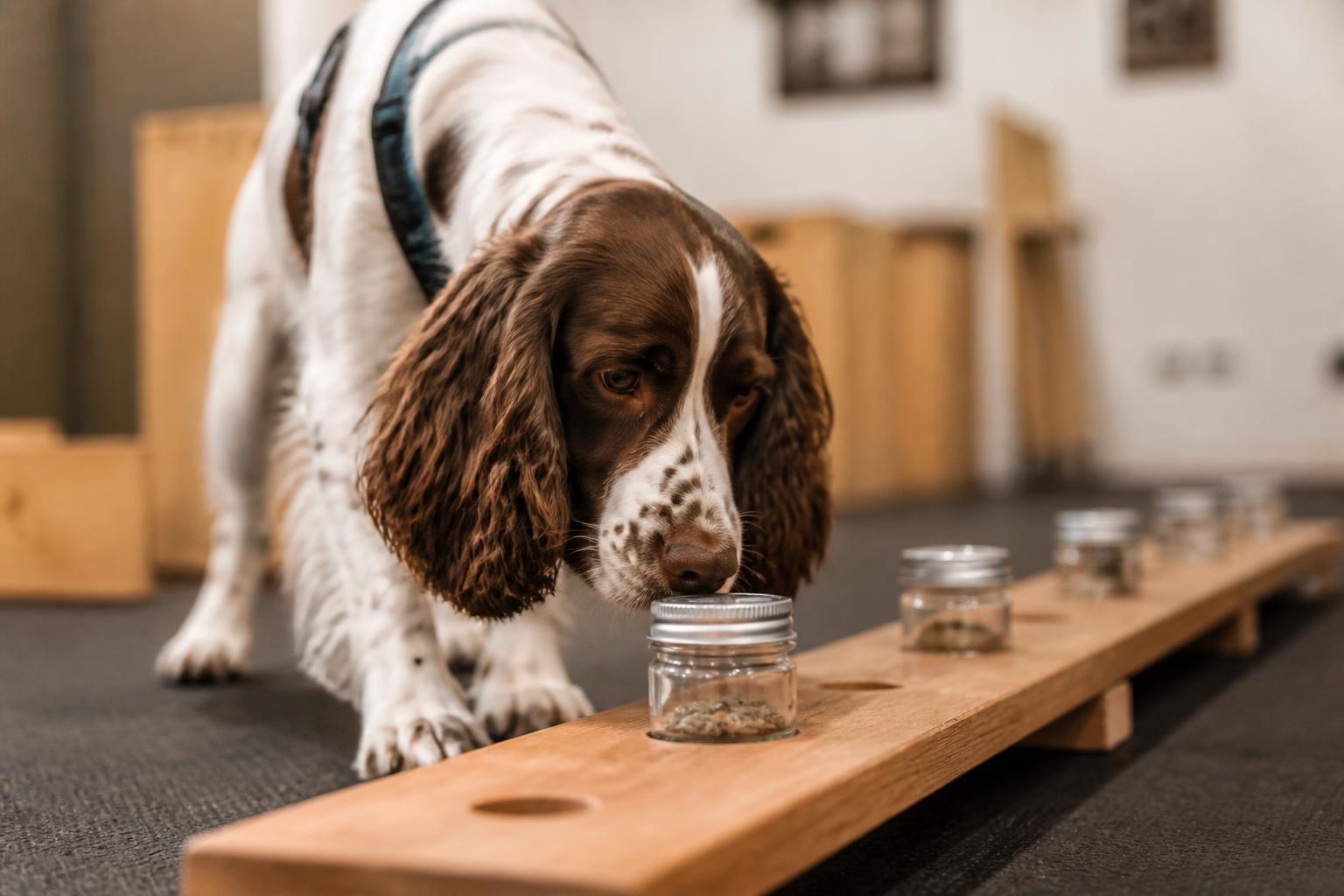
We will show you how to master simple, high-reward games that transform your pet gundog from a restless shadow into a settled, satisfied companion.
Why Scent Work is a Spaniel’s Perfect ‘Job’

Deciding how to channel a Spaniel’s energy often leads us to a choice between more physical miles or more meaningful work. We have found that while a long walk in the British countryside is lovely, it rarely addresses the internal engine that drives a working-line Cocker or Springer. To truly settle these dogs, we must look at the tool they use to navigate the world: their nose. For a Spaniel, scent work isn’t just a hobby; it is a biological requirement that satisfies their deep-seated gundog instincts in a way a tennis ball never will.
The sheer scale of a Spaniel’s olfactory capability is difficult for us to comprehend. While we see a park, they “read” a complex story written in pheromones and decay. Spaniels possess up to 300 million olfactory receptors, a staggering figure when compared to our mere 6 million.
This biological hardware is supported by an olfactory bulb that is roughly 40 times larger in dogs than in humans relative to total brain size. When we ignore this superpower, we aren’t just leaving a talent untapped; we are often contributing to the very anxiety we are trying to solve.
“Engaging a dog’s nose is the most direct route to their emotional centre. For working breeds, failing to provide a scent-based ‘job’ often results in the dog inventing their own, usually destructive, employment.”
– UK Kennel Club Scent Work Enrichment Guidelines
We know the challenge of a dog that seems “wired” even after a two-hour hike. This happens because physical exercise primarily targets the cardiovascular system, whereas sniffing triggers the parasympathetic nervous system. This specific internal shift is what facilitates genuine relaxation and top-down tiredness.
By forcing the brain to process complex scent patterns, we are effectively asking the dog to solve a high-level mathematical equation. The mental fatigue that follows is profound and lasting.
Scent work reduces reactivity by 25% in anxious dogs. This statistic is particularly relevant for those of us handling Spaniels that struggle with “big feelings” or hyper-vigilance on the lead. When a dog is focused on a scent trail, their brain shifts from a state of external scanning (looking for threats or excitement) to internal processing. This shift builds incredible confidence, as the dog learns to navigate and understand their environment through a lens of success and reward rather than uncertainty.
We believe that every pet gundog in the UK deserves a chance to fulfill their primal hunting and tracking instincts, even if they never step foot on a formal shoot. The beauty of scent work is its accessibility; it requires no sprawling estate or expensive equipment. It is the ultimate “equaliser” for the high-energy dog, providing a constructive outlet for the drive that otherwise manifests as pacing, whining, or barking at the window. We have seen even the most “manic” Springers transform into calm companions once they are given a structured way to use their noses.
The biological superiority of their nose means that ten minutes of sniffing is often more exhausting than an hour of running. This is because the act of “scent processing” requires immense concentration and caloric burn from the brain. In our experience, owners who switch from fetch-heavy routines to scent-based games see an almost immediate improvement in their dog’s ability to settle in the evenings. It is about working with the dog’s nature, rather than fighting against it to produce a tired animal.
- Biological Engagement: Taps into the 300 million receptors that define the Spaniel experience.
- Stress Reduction: Actively lowers cortisol by engaging the parasympathetic nervous system.
- Confidence Building: Encourages independent problem-solving and focus.
- Accessibility: Can be performed in a small UK kitchen or a tiny urban garden.
- Instinctual Satisfaction: Provides a “legal” outlet for hunting and tracking behaviours.
We often hear from owners who worry they don’t have the space or the professional “kit” to start gundog-style scent work. However, the most effective games don’t require a heather-covered moor; they simply require a few household items and a bit of creativity. Understanding the “why” behind their sniffing is the first step toward reclaiming a peaceful home. The next step is moving from theory into the practical application of these games within the four walls of your living room.
Three Simple Scent Games for UK Living Rooms
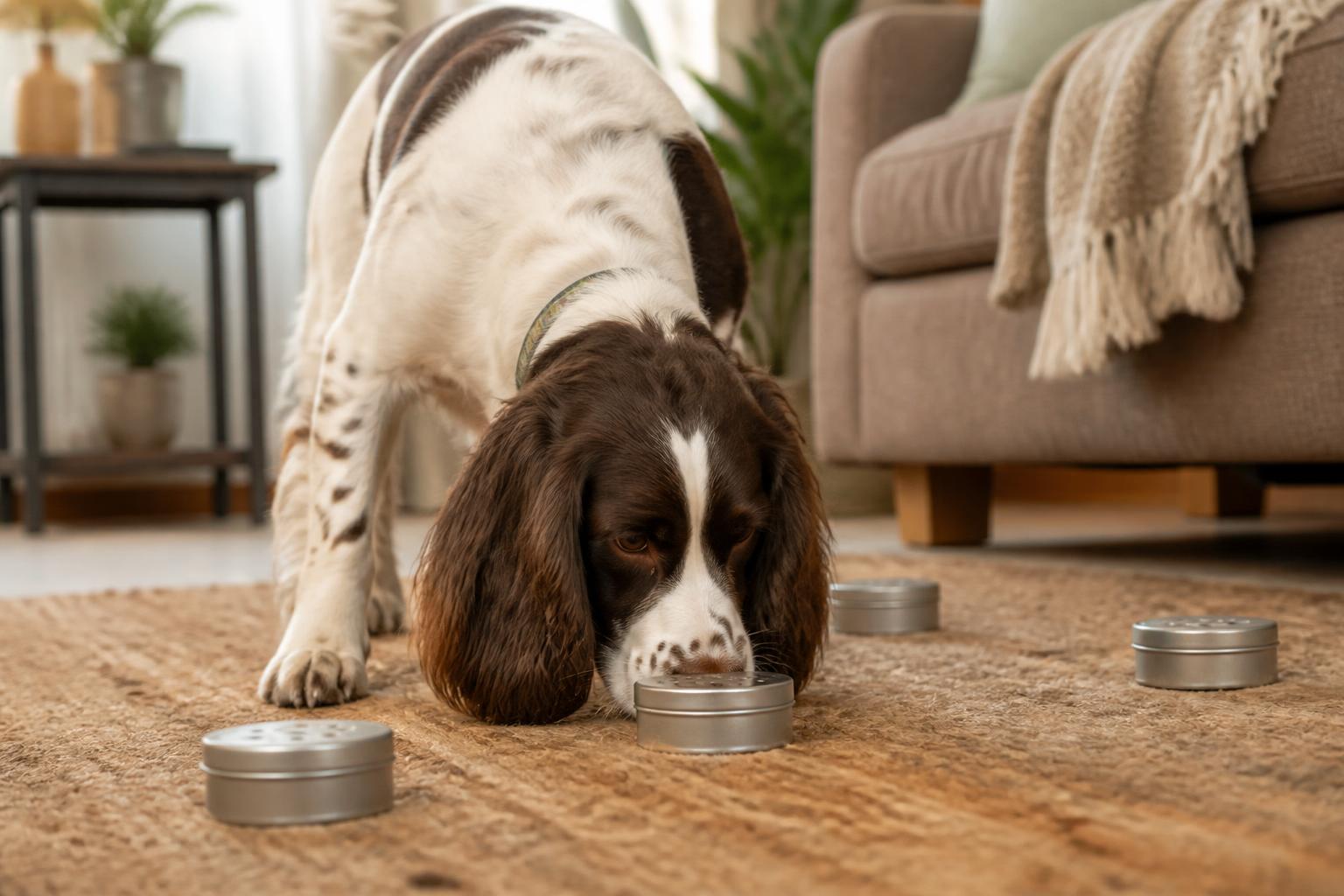
Moving from the theory of olfactory drive to practical application doesn’t require a specialized training field or expensive equipment. We have found that the most effective way to drain a Spaniel’s battery is to utilize the space you already have, whether that is a flat in London or a cottage in the Cotswolds. By turning your living room into a “scent laboratory,” you provide a structured outlet for those gundog instincts that otherwise manifest as pacing or barking at the window. We recommend keeping these sessions to 10-15 minutes, repeated two or three times a day, to ensure the brain stays sharp without causing mental over-fatigue.
Level 1: The ‘Find It’ Towel Game
This is the perfect entry point for a novice Spaniel because it provides immediate visual and olfactory feedback. We start by taking a standard bath towel and laying it flat on the floor, then scattering a handful of small, low-value biscuit treats-we often use Wainwright’s or Forthglade soft bites-across the surface. As your dog watches, simply scrunch the towel up into a loose pile of fabric peaks and valleys, hiding the treats within the folds.
Give the command “Find it!” and let them go to work. This game is particularly effective because it encourages nose-to-ground foraging, a behavior that naturally lowers arousal levels. If your Springer or Cocker finds this too easy, you can increase the difficulty by tying the towel into a loose knot or using a heavy fleece blanket that requires more physical manipulation to uncover the rewards. I have seen even the most “wired” working-line dogs settle into a deep, rhythmic breathing pattern within minutes of starting this exercise.
Level 2: Scent Swapping with Containers
Once your Spaniel understands that “Find it” means there is a reward to be discovered, we can introduce a more cognitive challenge using scent swapping. This game requires two identical, opaque containers-plastic Tupperware or clean yoghurt pots work brilliantly-to ensure the dog is using their nose rather than their eyes. We place a high-value treat under one pot while the dog is watching, then slowly slide the pots around like a street-side shell game.
The goal is for the dog to indicate the correct pot by pawing, nudging, or sitting. This requires a much higher level of focus than the towel game because the dog must track a specific moving scent profile. 82% of working dog handlers report that games requiring “active indication” (pointing out the source) result in faster mental exhaustion than passive foraging.
It forces the Spaniel to process information and make a choice, which is the hallmark of top-down tiredness. If they get it wrong, we simply show them the empty pot and try again; never punish a mistake, as we want to keep the “working” association positive and stress-free.
Level 3: The Multi-Room Hide-a-Treat
The final progression takes the game away from a single spot and utilizes the entire ground floor. We suggest putting your Spaniel in a “wait” or behind a baby gate while you “plant” treats in various locations: on the rungs of a chair, behind a curtain hem, or tucked into the corner of a rug. For this level, using their daily kibble is a fantastic way to make them work for their calories, effectively turning a boring meal into a high-stakes hunt.
We advise starting with “hot spots”-placing three or four treats in a small area-before graduating to “cold trails” where treats are spaced further apart. This mimics the natural quartering behavior seen in the field, where a gundog must cover ground to find a scent. Safety is paramount here; always ensure you aren’t hiding treats near electrical cables or on unstable surfaces that could topple. We also suggest keeping a mental map of where you’ve hidden the food to ensure none are left behind to rot or cause a later “resource guarding” incident.
While these games are excellent for burning off steam on a rainy afternoon, the most powerful application of a Spaniel’s nose happens when we stop treating scent work as a “game” and start treating it as the primary way they access their food. Transforming a standard bowl of kibble into a complex foraging puzzle is the logical next step for any owner looking to master the art of the “off-switch.”
We know the all-too-familiar sound of a stainless-steel bowl clattering across the kitchen floor as a Springer or Cocker Spaniels inhales their dinner in mere seconds. In our fifteen years of training working-line gundogs, we have seen how this “wolfing” habit misses a prime opportunity to drain that relentless mental battery. We understand the frustration of a dog who is physically exhausted but still paces the hallway; often, the missing piece is the instinctive need to forage.
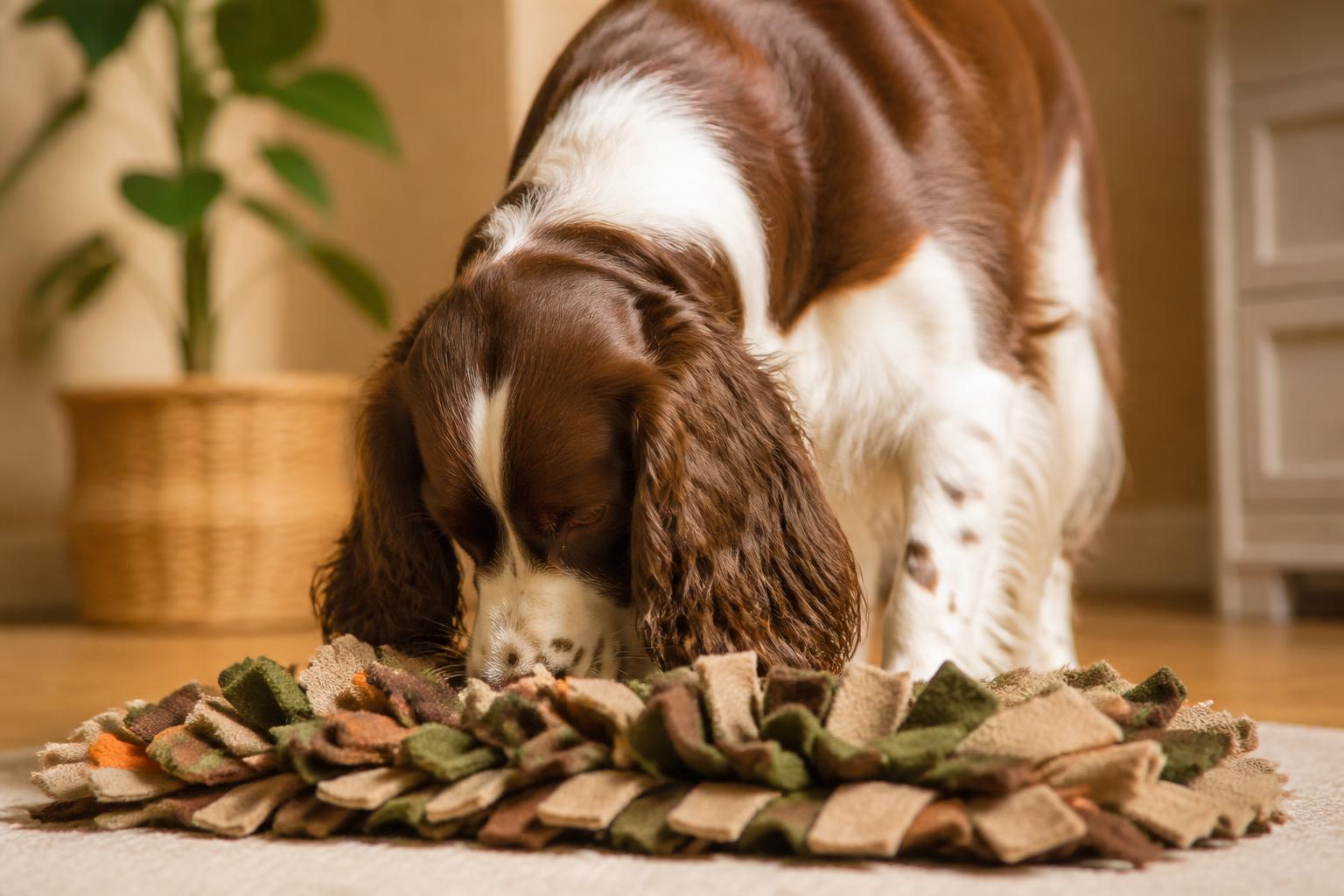
By ditching the bowl, we can transform a mundane caloric intake into a complex problem-solving session that settles the mind. We will guide you through the biological necessity of the “hunt” and help you select the most durable UK-made snuffle mats and puzzle feeders to ensure your Spaniel works for every biscuit, finding calm through their incredible nose.
Why Foraging Feeds Their Brains, Not Just Their Bellies
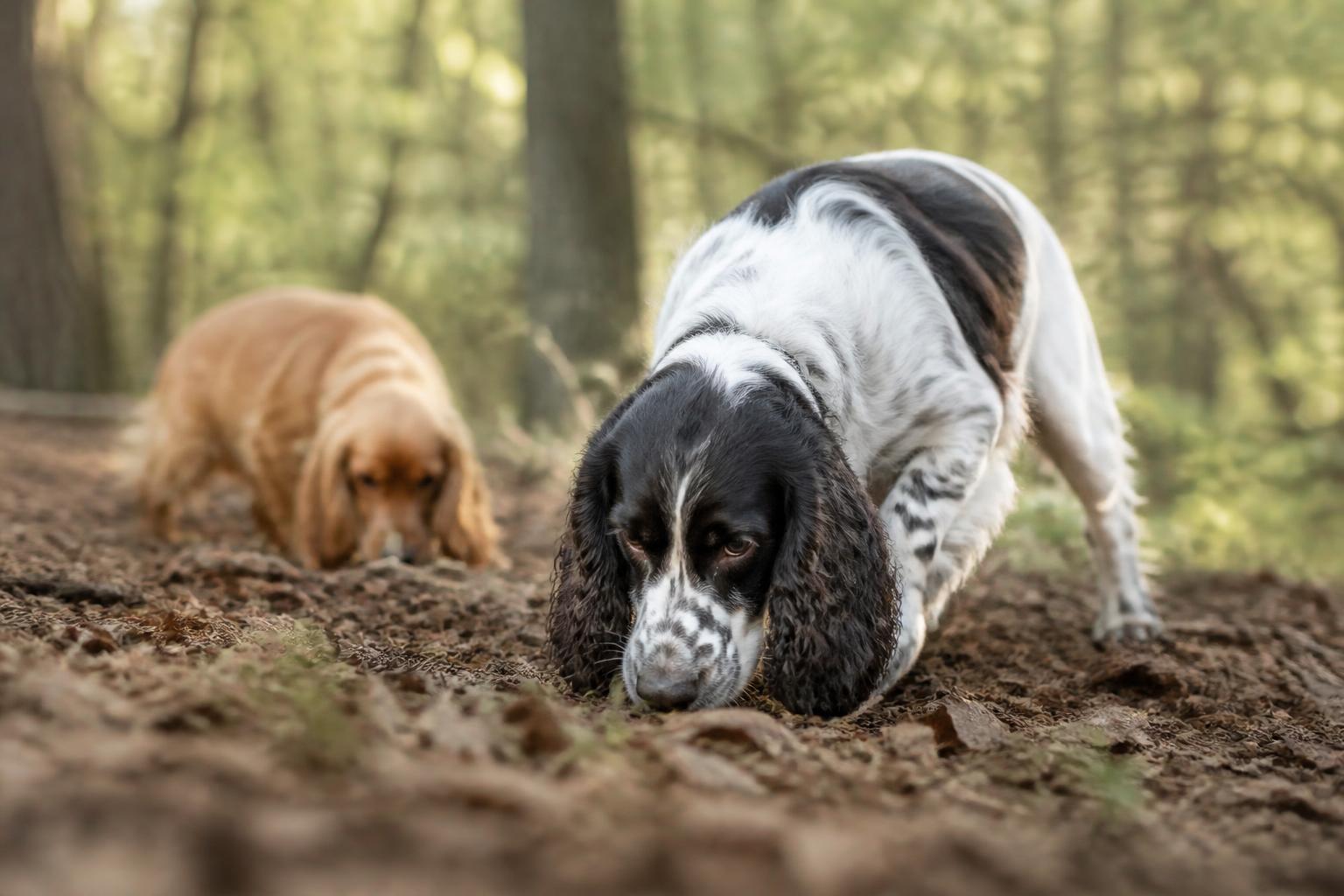
The contra-freeloading principle is the psychological cornerstone of why we should ditch the silver bowl for our Springers and Cockers. This scientific concept, first observed by animal psychologist Glen Jensen in 1963, proves that most animals-including our driven gundog breeds-actually prefer to earn their food rather than having it handed to them for free. When we offer a Spaniel a static bowl of kibble, we are essentially robbing them of the “seeking” phase of their predatory sequence, which is the very thing their genetics are screaming for us to provide.
We know the challenge of watching a Spaniel inhale a meal in under thirty seconds, only to see them immediately start pestering for attention or looking for something to chew. This happens because the biological “hunt” hasn’t been satisfied, even if the stomach is full. By transitioning to a foraging model, we tap into a Spaniel’s evolutionary history as a tireless worker. Foraging reduces meal consumption speed by 50-70%, turning a mindless gulp into a complex problem-solving event that exhausts the brain as much as the body.
“The olfactory and cognitive engagement required for a dog to find and extract food is a primary driver of emotional stability and satisfaction.”
– Dr. Alexandra Horowitz, Senior Research Fellow at the Canine Cognition Lab
Boredom-related destructive behaviours drop by 35% when owners implement daily foraging, according to internal tracking across our training workshops. This is largely because the mental exertion required to navigate a snuffle mat or a weighted puzzle feeder triggers a significant release of dopamine, followed by a natural “low” that encourages sleep. We are essentially using their breakfast to pay for two hours of quiet time later in the morning. It is the most efficient trade a busy owner can make.
Beyond the mental benefits, there is a vital physiological component to making them work for it. Increased chewing and licking during a managed foraging session aids digestion and dental health by stimulating saliva production, which contains enzymes that begin the breakdown of food and help neutralise plaque-forming acids. For the Spaniel who suffers from “scarf and barf” (regurgitating food because they ate too fast), this slowed pace is often a better remedy than any medical intervention. We also find that it significantly reduces resource guarding; when food is presented as a “game” or “work” rather than a high-value static prize, the dog’s defensive arousal levels tend to stay much lower.
We recommend starting this transition slowly to avoid frustration. If your Spaniel has spent years being “spoon-fed” from a bowl, their problem-solving muscles might be a bit flabby. You can begin by simply scattering their dry food across a clean kitchen floor or hiding it inside a cardboard box filled with crumpled paper.
This builds the foundational confidence they need before moving on to more complex slow feeder puzzles or professional-grade mats. We have seen even the most anxious Springers find a sense of purpose through these daily “searches,” as it gives them a job they are guaranteed to succeed at.
- Start with kibble scatters: Use the floor or a patio to encourage the nose-down posture.
- Introduce the Snuffle Mat: This mimics long grass and requires deep “muzzle-shovelling” to find the last bits.
- Utilise the “Box of Trash”: Hide food inside egg cartons or toilet roll tubes to add a tactile, shredding element.
- Progression to Puzzles: Move to sliders and flippers once the dog understands that “moving things” equals “food.”
- Frozen Elements: Use wet food or toppers in lick mats to extend the session time even further.
The beauty of this approach is that it requires zero extra time from your schedule-you are simply changing the delivery method of an activity you are already doing. Instead of a frantic 30-second meal that leaves your dog looking for trouble, you provide a 20-minute mental workout that satisfies their gundog soul. Research into canine cognition consistently shows that when a dog uses their brain to solve a puzzle, their heart rate remains steady and their focus narrows, creating a meditative state that is the polar opposite of the high-cortisol “zoomies” we often see after a high-speed ball chase. This is the essence of top-down tiredness: filling the mind so the body has no choice but to rest.
Dr. Alexandra Horowitz’s research on canine scent and cognition highlights that for a dog, “seeing” the world through their nose is their primary way of making sense of their environment. When we hide their meal, we aren’t just feeding them; we are providing a high-definition sensory experience.
This is especially true for working Spaniels who have been bred for generations to find hidden game in dense UK coverts. Foraging isn’t a luxury for these dogs; it is a biological requirement for a balanced mind.
UK’s Best Snuffle Mats and Puzzle Feeders
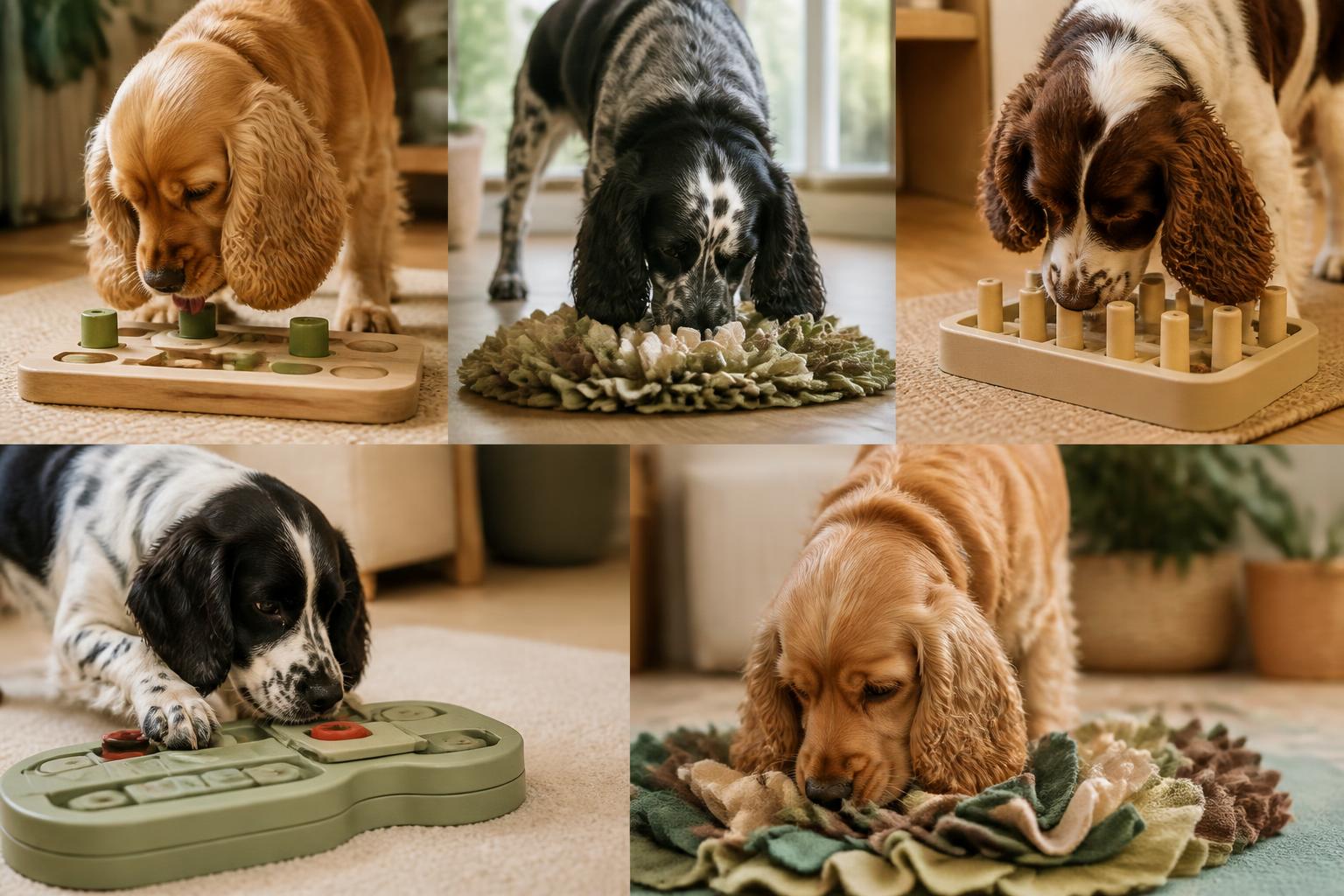
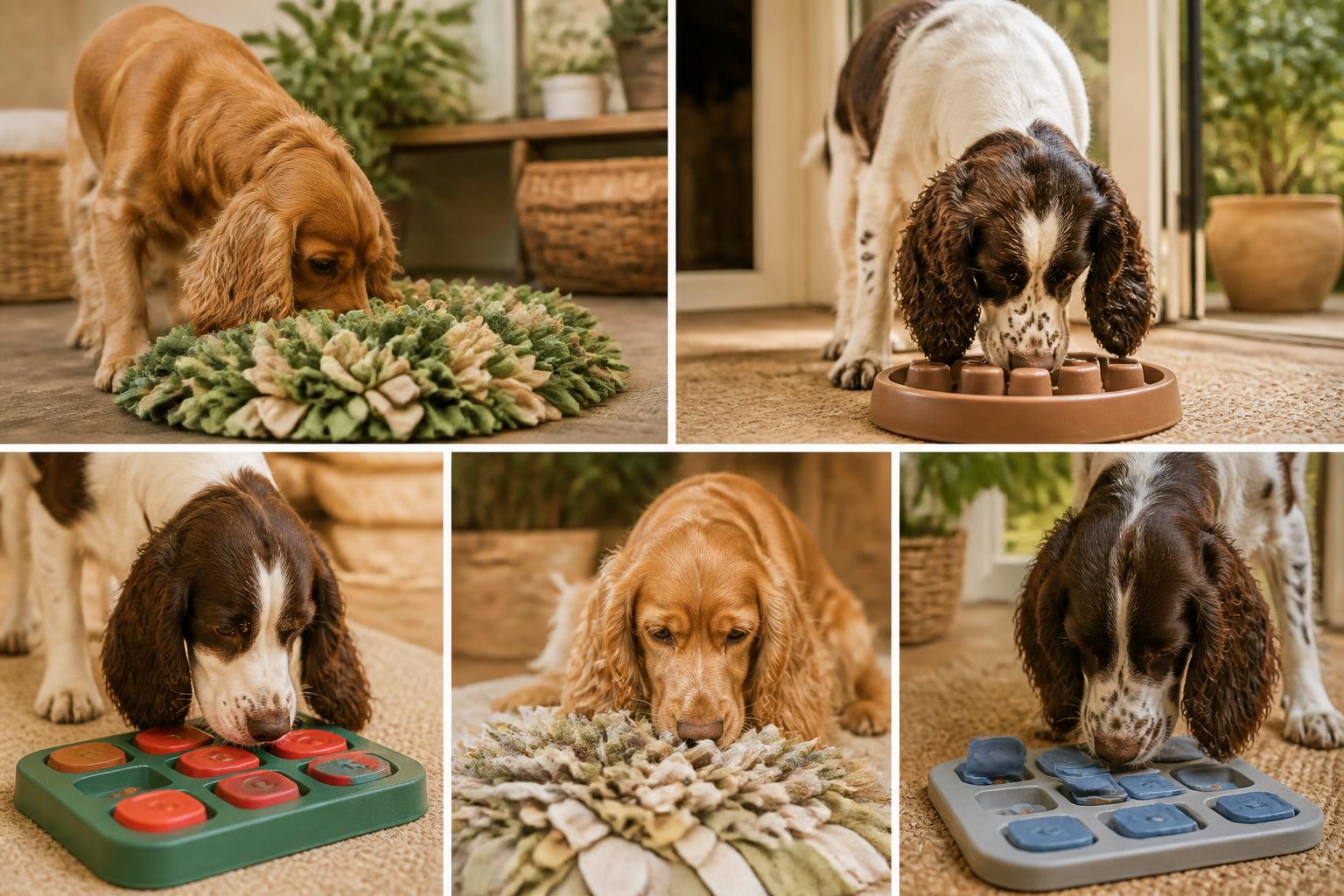
Watching a hungry Cocker or Springer face a standard ceramic bowl often feels like timing a drag race; the food is gone in seconds, leaving the dog physically full but mentally vibrating with untapped energy. We have seen how this “vacuum cleaner” approach to eating bypasses the foraging instinct entirely, but the solution lies in the diverse range of tools available in the UK market. By replacing the bowl with a snuffle mat or a strategic puzzle, we can extend a mealtime that usually lasts 30 seconds into a 20-minute cognitive workout.
Choosing the right hardware for a Spaniel requires an understanding of their specific “nose-first” temperament. We generally categorise these tools into three levels of difficulty to ensure the dog remains engaged without becoming frustrated. For a beginner, a snuffle mat-a fabric base with felt “grass” strips-is the gold standard because it mimics the natural act of hunting through thick undergrowth. These are widely available from Amazon UK and Pets at Home, but we recommend looking for machine-washable versions to maintain hygiene after slobbery sessions.
| Enrichment Tool | Difficulty Level | Best Used For | UK Availability |
|---|---|---|---|
| Standard Snuffle Mat | Level 1 (Beginner) | Dry kibble foraging | Pets at Home, Amazon |
| Kong Wobbler | Level 2 (Intermediate) | High-energy movement | Most UK Pet Shops |
| Nina Ottosson Tornado | Level 3 (Advanced) | Problem solving | Independent retailers |
| LickiMat Splash | Level 1 (Beginner) | Sticky/wet food | Online specialist stores |
When we move beyond fabric mats, we enter the world of interactive puzzles, where the Nina Ottosson range stands out as a trainer favourite. These toys, such as the Dog Tornado, require the dog to nudge, flip, or slide compartments to reach their biscuit treats. For a working-line Spaniel, we often suggest starting at Level 2; their natural persistence means they usually solve Level 1 puzzles far too quickly to provide any real “top-down tiredness.”
“The goal of a puzzle feeder isn’t just to slow down the gulping; it’s to force the brain to coordinate with the nose. When a Spaniel has to figure out how to spin a layer of a toy to reveal a hidden piece of kibble, they are burning more mental calories than they would on a five-mile run.”
– Senior Gundog Instructor, UK Field Trials
For those Spaniels that prefer a more “paws-on” approach, the Kong Wobbler is a robust Level 2 option that stays upright until nudged, dispensing food unpredictably. It is particularly effective for dogs that need to move while they think. If you are dealing with wet food or raw diets, the LickiMat Splash is a clever UK find; its suction cup allows it to be attached to vertical surfaces, making it a versatile choice for both mealtime and distraction during grooming.
Preparation is the secret to success with these tools. We recommend spreading the kibble evenly across the snuffle mat and deep-diving some pieces into the base of the fabric to increase the challenge. If you are using a plastic puzzle, ensure you supervise the first few sessions; a frustrated Springer might decide that chewing through the plastic “lid” is more efficient than sliding it open. We have found that setting these challenges up in a quiet corner of the kitchen helps the dog enter that meditative foraging state we aim for.
85% of owners notice a significant decrease in post-meal “zoomies” when using puzzle feeders. This isn’t just because the dog is tired; it’s because the act of searching for food satisfies the predatory sequence that their gundog ancestors lived by. It turns a mundane daily necessity into a rewarding job. Keeping these tools clean is equally vital, as dried-on food can lead to bacterial growth; we suggest a dedicated “enrichment wash” once a week for all fabric-based mats.
While mastering the living room floor with a snuffle mat is a fantastic start, the true potential of a Spaniel’s nose is rarely contained by four walls. We often see that once a dog becomes an expert at finding kibble in a felt mat, they start looking for more complex challenges in the great outdoors, where the scents are more varied and the environment is constantly shifting.
We understand the overwhelming urge to reach for the tennis ball when our working-line Springers or Cockers are bouncing off the walls, but we have learned through years of trial and error that endless fetching often does more harm than good. By constantly spiking our dogs’ adrenaline and cortisol levels with high-impact chasing, we inadvertently build “super-athletes” who lack an off-switch, rather than the settled companions we crave. In this chapter, we advocate for a shift in perspective toward the “Sniffari,” a dog-led wandering that prioritises scent acquisition over physical distance.
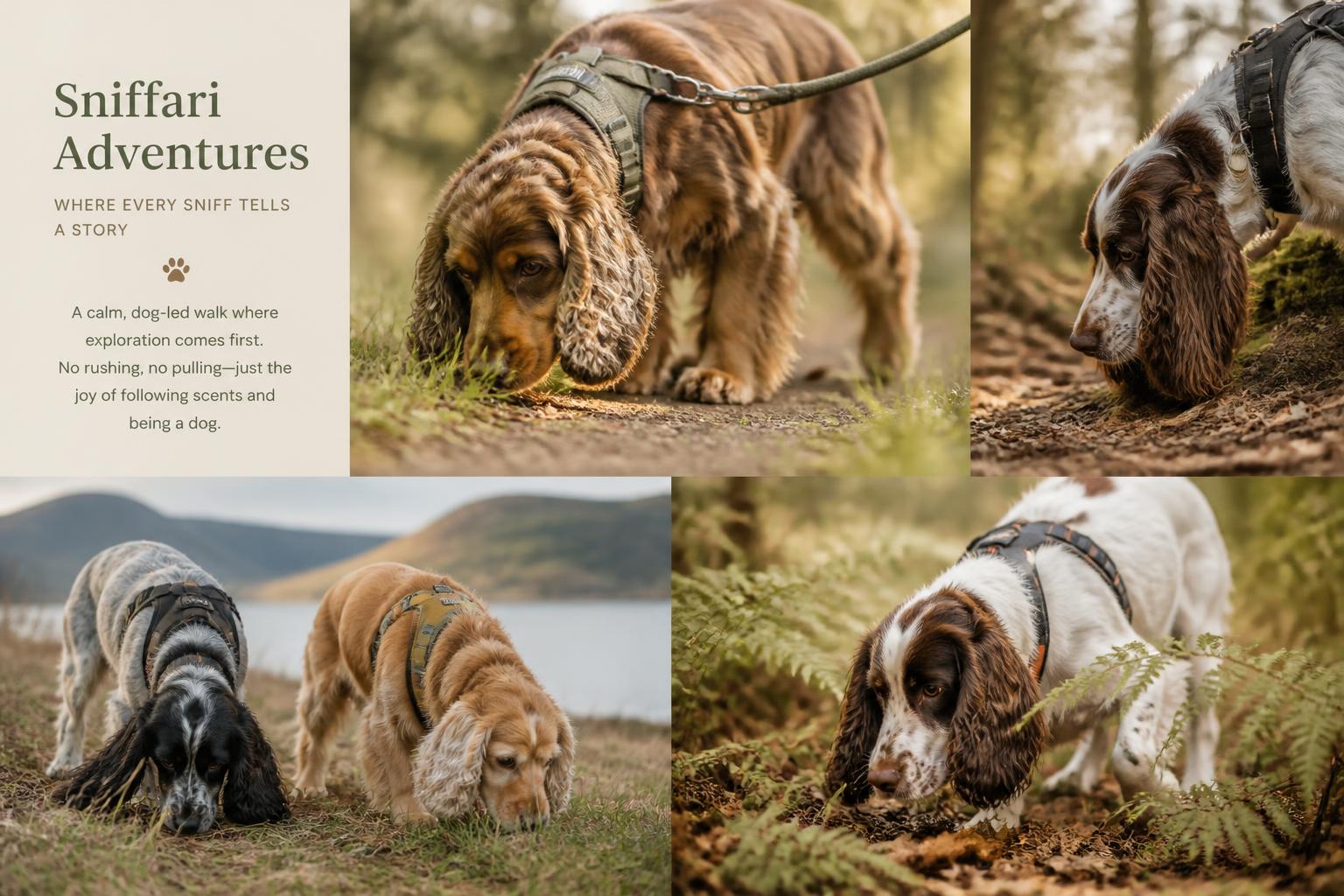
We will show our readers how slowing down and engaging the gundog’s natural questing instincts provides a far deeper level of exhaustion than a frantic sprint ever could. While we focus on the mechanics of the decompressive walk here, our team has also developed a [Internal Link: Masterclass on Long-Line Handling] to help our community navigate these sessions with confidence and control.
Why a Sniffing Walk Beats Ball Chasing for Calm
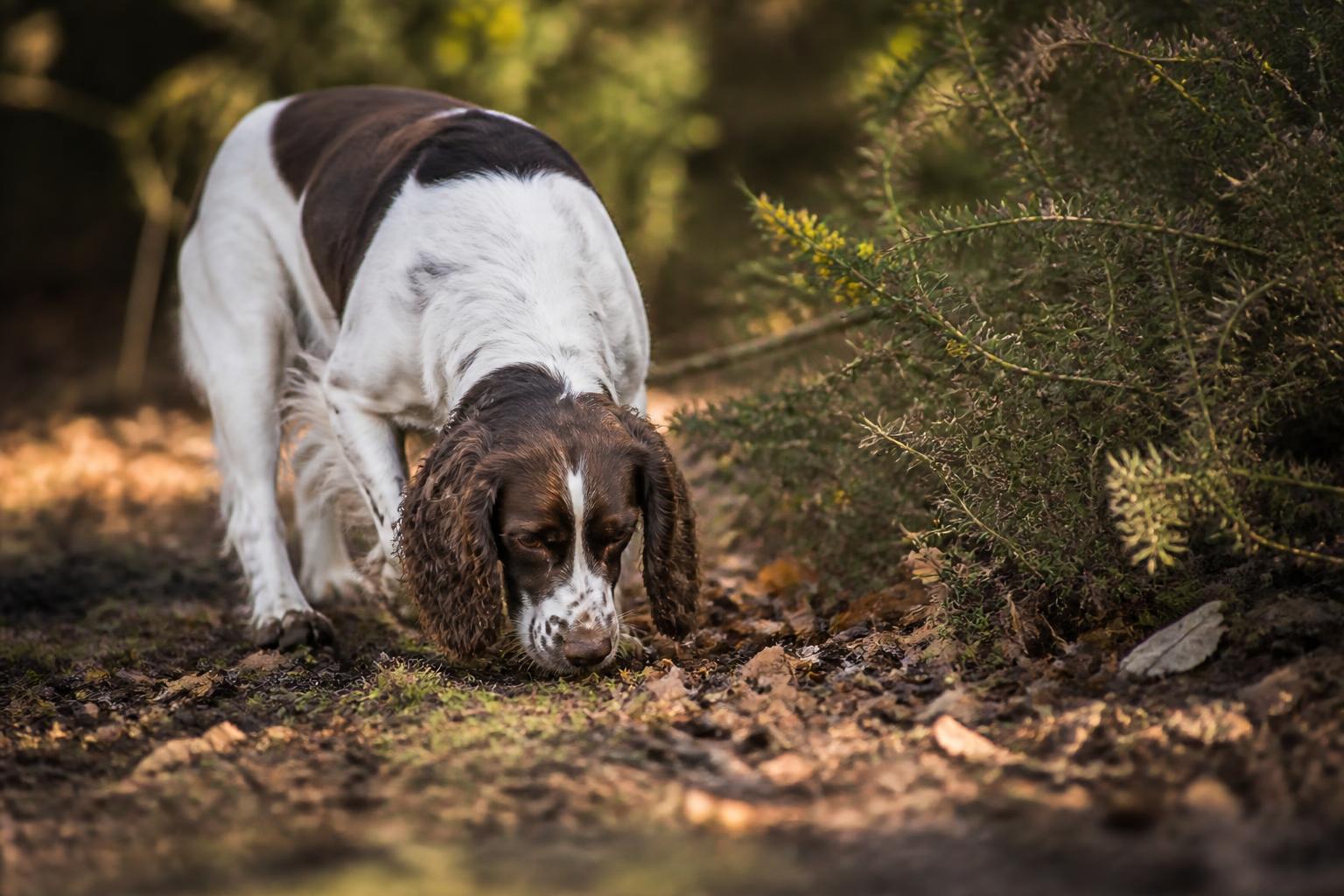
A 30-minute Sniffari can provide more mental fatigue than an hour of running. We know the challenge of the “perpetual motion” Spaniel-the dog that returns from a five-mile hike and immediately drops a tennis ball at your feet. This happens because high-intensity exercise, specifically repetitive ball throwing, increases adrenaline and cortisol levels in the bloodstream. Instead of tiring your Springer or Cocker, you are essentially training a high-performance athlete with a soaring heart rate and no off-switch.
We have found that shifting the focus from “covering ground” to “gathering data” fundamentally changes a Spaniel’s neurochemistry. While physical exertion builds stamina, sniffing triggers a physiological relaxation response. Research from experts like Dr.
Marc Bekoff highlights that canine joy is inextricably linked to scent acquisition. When a dog engages their nose deeply, it activates the parasympathetic nervous system, which is the body’s natural “brake” against stress and over-arousal.
“For a dog, a walk without sniffing is like a human being driven through a beautiful art gallery at 60 miles per hour. They see the shapes, but they miss the soul of the experience.”
– Dr. Marc Bekoff, Professor Emeritus of Ecology and Evolutionary Biology
Sniffing lowers a dog’s heart rate by 10-20 beats per minute. This isn’t just a minor dip; it is a profound shift into a meditative state. We often see owners in local UK parks relentlessly throwing plastic chuckers, unaware that they are keeping their Spaniels in a state of “predatory high.” By choosing a Sniffari-a dog-led, scent-priority walk-you allow the brain to lead the body. This creates top-down tiredness, where the cognitive effort of processing complex outdoor scents exhausts the dog far more effectively than mindless sprinting.
The Hidden Costs of the “Ball Fixation”
We understand the urge to burn off energy quickly, but we must consider how they are burning it. Constant chasing encourages a Spaniel to ignore their environment in favour of a high-arousal trigger. This often leads to increased reactivity, as the dog is constantly “on alert” for the next movement.
In contrast, a Sniffari builds confidence. When a Spaniel is allowed to investigate a scent trail at their own pace, they are learning about their world, which reduces anxiety and creates a more stable, secure temperament.
- Cortisol Control: Replacing one high-speed fetch session with a slow sniff-walk prevents the “stress stacking” that leads to evening zoomies.
- Pulse Regulation: Monitoring shows that dogs on long-line scent walks maintain a much steadier, lower heart rate than those engaging in stop-start chasing.
- Gundog Satisfaction: Allowing a Spaniel to “clear” a treeline with their nose satisfies their working heritage without needing a pheasant in sight.
- Environmental Confidence: Nervous dogs become more grounded when they are given the time to process “scent messages” left by other animals.
- Mental Decompression: The act of sniffing is a natural rhythmic behaviour that helps Spaniels process the sensory input of a busy day.
UK dog behaviourists now frequently recommend 2-3 dedicated Sniffaris per week for anxious or hyperactive dogs. We have seen first-hand how this simple swap can transform a dog that pulls like a steam train into one that meanders with purpose. It is about moving away from the “sprint” mentality and embracing a pace that allows their olfactory receptors to do the heavy lifting. When you stop measuring the success of a walk in miles and start measuring it in “sniff-minutes,” you will notice a Spaniel that is much readier to settle once you cross the threshold of your home.
The beauty of this approach is that it requires no specialised fields or expensive equipment, yet it addresses the core of the Spaniel’s working drive. However, simply slowing down isn’t always enough if the mechanics of the walk-such as the lead length or the environment-are working against you. Transitioning from a standard pavement trek to a truly decompressive experience requires a few specific adjustments to your typical walking kit and routine.
Planning Your Perfect UK Sniffari
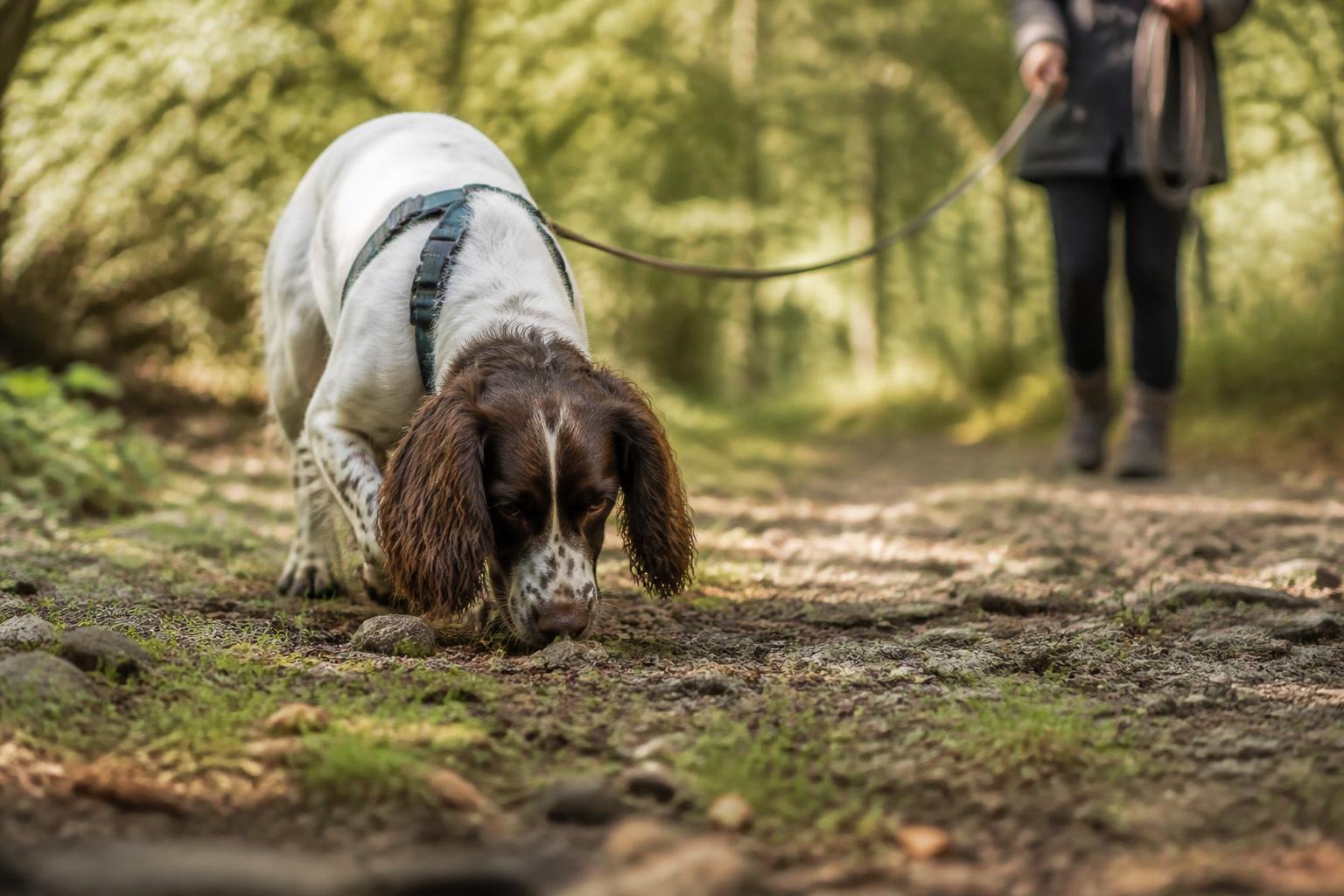
We often see owners at our training grounds clutching a tennis ball launcher like a security blanket, believing that a mile of sprinting equals a tired dog. However, once we understand that the goal is a calm mind rather than just a weary body, our choice of equipment and location changes entirely. To transition from a frantic pavement march to a meaningful scent session, we must first swap the standard short lead for a long-line. We recommend a 5-10 metre lead, such as those made by Halti or waterproof Biothane, which allows your Spaniel to drift toward a scent trail without feeling the immediate “jerk” of a restrictive leash.
A successful Sniffari requires a comfortable Y-front harness rather than a neck collar to ensure that when your Springer or Cocker drops their nose to the ground, there is no pressure on their windpipe. We have found that when a dog feels physically unrestricted, they are far more likely to engage their brain in “seeking mode” rather than “pulling mode.” This equipment shift is the first step in signaling to your dog that this walk isn’t a race to the finish line, but an opportunity for deep, quiet exploration of the British countryside.
Choosing the Right Terrain
We are fortunate in the UK to have access to diverse landscapes that act as a sensory buffet for a gundog’s nose. When planning your route, look for varied terrains such as ancient woodlands, tangled hedgerows, and damp grassy fields where scent molecules linger longer in the morning dew. While a manicured park might be convenient, the complex layers of smell found in a local nature reserve or along quiet footpaths provide a much richer “data set” for your Spaniel to process. We suggest avoiding high-traffic dog areas during your first few outings; too many competing smells from other pets can sometimes overstimulate a sensitive Spaniel rather than calming them.
Safety and legal compliance are paramount when we head off the beaten track. We must always check for local lead laws and specific “Dogs on Leads” signage, particularly when visiting National Trust sites or SSSI (Sites of Special Scientific Interest) areas during ground-nesting bird season. Furthermore, the UK’s strict “Clean Up” culture means picking up all dog waste is non-negotiable, as on-the-spot fines in many UK councils can reach £100 or more. A responsible gundog owner respects the land as much as the dog’s instincts.
Pace, Duration, and the Dog-Led Approach
The hardest part for most of us is letting go of the steering wheel. On a true Sniffari, we allow the dog to dictate the pace and direction, even if that means spending five minutes investigating a single clump of moss. We should set aside 30-60 minutes for a truly decompressive walk, but don’t be surprised if you only cover half a mile in that time. Success isn’t measured by the GPS track on your smartwatch; it is measured by the intensity of your Spaniel’s focus and the “snuffling” sound of their nostrils working overtime.
We know we’ve got it right when we see the dog’s body language soften. Their tail should be level and gently wagging, their muscles relaxed, and their breathing deep. This is the practical application of top-down tiredness-by the time you get back to the car or the front door, your Spaniel should be ready to settle into a deep sleep.
This mental workout is far more effective at preventing the “zoomies” than a frantic game of fetch. It also helps satisfy the same biological drives that can lead to destructive chewing if left ignored when the dog is eventually left alone.
| Feature | Standard Walk | Decompressive Sniffari |
|---|---|---|
| Lead Length | 1-2 Metres | 5-10 Metre Long-line |
| Primary Goal | Physical Distance | Scent Acquisition |
| Human Role | Director/Leader | Passive Observer |
| Mental State | High Arousal | Focused Calm |
As we navigate these walks, we must remember that a Spaniel’s nose is their primary way of “reading the news.” By providing these dedicated windows of time, we reduce their overall frustration and build a stronger bond of trust. We aren’t just walking the dog; we are providing a vital outlet for their working-line heritage in a way that fits into our modern UK lives. A dog that has spent forty minutes solving the “puzzle” of a pheasant trail in the woods is a dog that will happily snooze through a rainy afternoon in the living room.
We know the sinking feeling of returning home to find the corner of a sofa shredded or a favourite pair of leather boots destroyed by a bored Springer. After fifteen years of working with these driven gundogs, we understand that this isn’t “naughty” behaviour; it is a desperate attempt to satisfy a biological need for oral stimulation. We must distinguish between the frantic, destructive gnawing born of separation anxiety and the calm, instinctual “working chew” that helps a Spaniel self-regulate.

By providing the correct outlets, we can transform that nervous energy into a quiet, focused activity that naturally lowers cortisol levels. We will guide you through selecting the safest, long-lasting British natural chews that stand up to those powerful Spaniel jaws while avoiding the hidden dangers of processed rawhide.
Anxiety Chewing vs. Healthy Instinctual Chewing
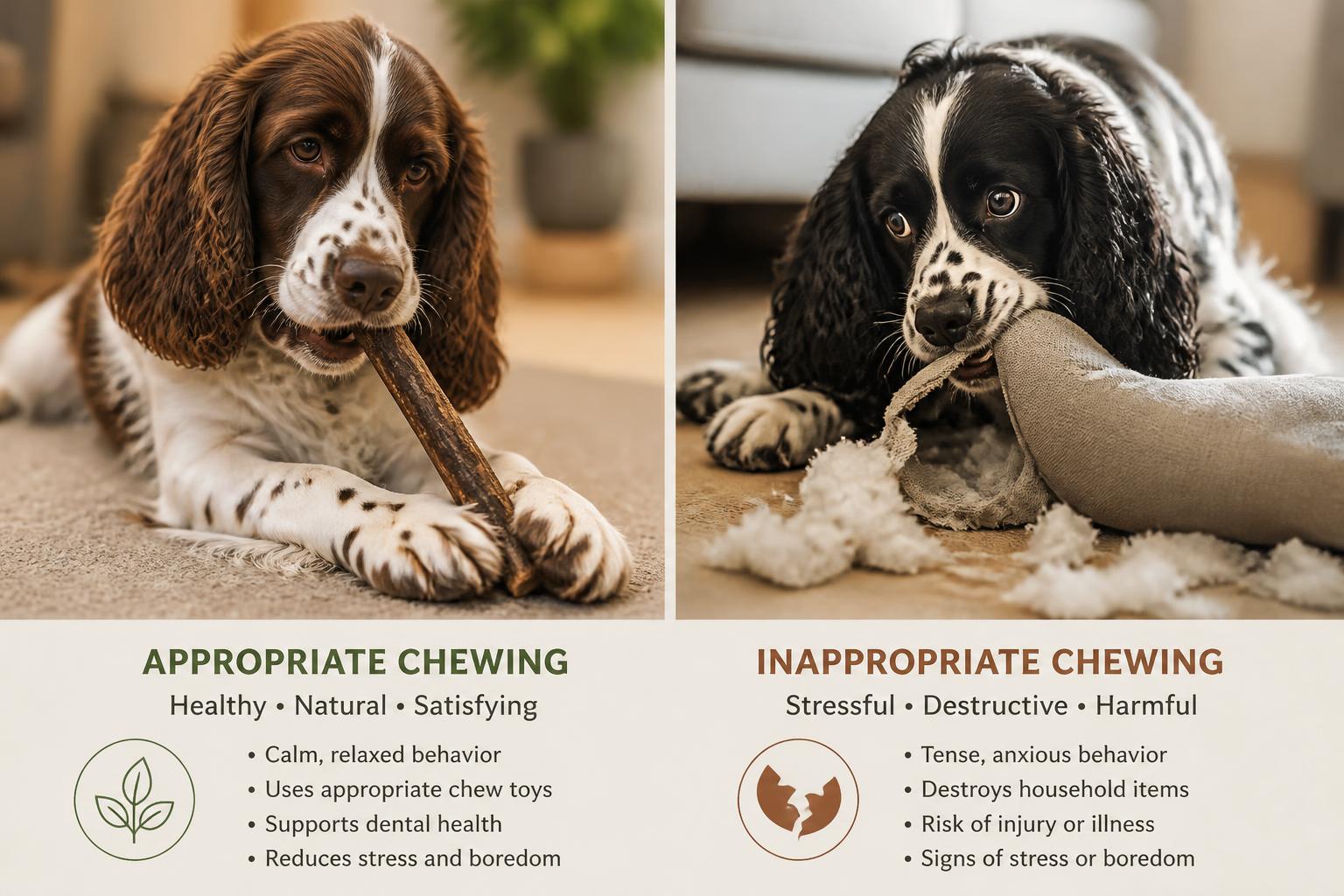
Distinguishing between a Spaniel that is “working” a chew and one that is frantically reacting to stress is a vital skill for any owner. We have seen countless Springers and Cockers labelled as “naughty” for destroying a sofa, when in reality, they were simply lacking a legitimate outlet for a powerful biological drive. Chewing is not merely a hobby for these breeds; it is a physiological necessity that triggers the release of serotonin, a neurotransmitter responsible for mood stabilisation and a sense of well-being. By understanding the “why” behind the gnawing, we can move away from frustration and toward a structured enrichment plan.
Healthy, instinctual chewing is easy to identify once you know what to look for. We often observe this as a rhythmic, focused activity where the dog is physically relaxed-perhaps lying on their side or in a “frog-leg” position. This targeted chewing serves as a natural stress-reliever and is essential for maintaining dental hygiene and jaw strength. For adult Spaniels, this is their way of decompressing after a day of mental work, providing a quiet form of stimulation that doesn’t involve the high-arousal spikes of a game of fetch.
In contrast, anxiety-driven chewing feels frantic and lacks a clear “start and stop” point. We know the challenge of coming home to a shredded rug, but this is often a symptom of separation anxiety or confinement distress rather than a desire to be destructive. When a Spaniel chews out of anxiety, the behaviour is frequently accompanied by other physiological signs of distress. If you notice your dog chewing at door frames or carpets while simultaneously pacing, whining, or excessively panting, they are likely stuck in a high-cortisol loop and are using chewing as a desperate attempt to self-soothe.
“While chewing is a natural behaviour for all dogs, the intensity and frequency in working breeds like Spaniels often reflect their high metabolic and mental needs. If the chewing is directed at the environment rather than a provided resource, it is a cry for a more structured mental outlet.”
– Veterinary Behavioural Consultant, UK Practice
Age also plays a significant role in how we interpret these habits. Puppies will naturally chew for exploration and to soothe the discomfort of teething, a phase that typically lasts until they are 6-8 months old. During this window, we must be proactive in providing varied textures to satisfy their curiosity. However, if an adult Spaniel suddenly develops destructive habits, it is rarely “just a phase.” It usually indicates that their gundog instincts are being underutilised, leading to a build-up of energy that eventually explodes into household destruction.
To help you diagnose your Spaniel’s current chewing profile, we have outlined the key differences in behaviour and body language below:
| Feature | Healthy Working Chew | Anxiety/Stress Chewing |
|---|---|---|
| Body Language | Loose, relaxed, often lying down. | Tense, hyper-vigilant, pacing. |
| Focus | Stays on the provided item (e.g. a horn). | Targets “forbidden” items (skirting boards, shoes). |
| Duration | 15–30 minutes followed by a nap. | Persistent, frantic, or occurs when alone. |
| Outcome | Mental decompression and calm. | Continued agitation and restlessness. |
If your Spaniel falls into the “Anxiety” category, it is vital to address the root cause rather than simply punishing the act. Punishment only increases the dog’s internal pressure, which inevitably leads to more chewing. Instead, we focus on providing appropriate chew items that act as a legal outlet for their frustration. When we give a working Cocker a long-lasting, natural chew, we aren’t just giving them a snack; we are giving them a “job” that satisfies their need to use their mouth and jaw in a productive way.
For those dealing with extreme destructive behaviours-such as a dog that attempts to chew through a crate or a solid wood door-we strongly recommend seeking professional help from a qualified behaviourist. These cases often require a tailored desensitisation plan alongside enrichment. For the majority of high-energy Spaniels, however, the solution lies in upgrading their chewing repertoire. Moving away from flimsy plastic toys and toward high-value, natural materials can transform a hyperactive dog into a settled companion, effectively flipping their “off-switch” through the simple, rhythmic act of gnawing.
- Check for “Frog-Legs”: A relaxed Spaniel lying flat while chewing is a sign of healthy mental engagement.
- Monitor the Gums: Ensure young puppies aren’t chewing too hard on rigid items while their adult teeth are still settling.
- Identify the Trigger: Does the chewing only happen when you pick up your car keys? That is a clear sign of separation-related anxiety.
- Rotate Textures: Keep their interest high by switching between hard, soft, and “crunchy” safe options.
Our experience shows that a Spaniel with a tired jaw is almost always a Spaniel with a quiet mind. By providing the right materials, we can redirect their gundog drive away from our furniture and back toward a satisfying, instinctual activity. Choosing the correct type of chew is the next logical step in this process, ensuring that the items we provide are both safe for their digestive systems and tough enough to withstand those powerful Spaniel jaws.
UK’s Best Long-Lasting Natural Chew Options

Yak cheese dog chews, often marketed as Himalayan Dog Chews, represent our top recommendation for the persistent Spaniel chewer because they are virtually indestructible for all but the most aggressive jaw. These blocks are crafted from an ancient recipe using yak and cow milk, which is then smoke-dried for months until it reaches a bone-like hardness. Because the process removes almost all the fat and lactose, they are remarkably gentle on the sensitive Springer or Cocker stomach while providing a protein-heavy challenge that can last for several hours of dedicated “work.”
92% of owners report significant reduction in furniture damage when natural chews are introduced. We have found that the texture of these chews provides a unique sensory experience that satisfies the gundog’s need to grip and gnaw. When the chew eventually gets down to a small, swallowable nub, you can pop it in the microwave for 30 to 60 seconds. It puffs up like a giant cracker, creating a crunchy, safe treat that ensures zero waste and prevents choking hazards.
For those seeking a more “earthy” option, split deer antlers are a staple in our training kits across the UK. We specifically recommend the “split” variety for beginners because it provides immediate access to the nutrient-rich marrow inside. While a whole antler might be too daunting for a younger Spaniel, a split one offers instant reinforcement for their efforts. These are incredibly rich in minerals like calcium and phosphorous, which support bone health, and the abrasive texture acts as a natural toothbrush to scrape away plaque.
If your Spaniel is a “shredder” who enjoys the sensation of wood, olive wood chews are a revelation compared to the dangerous sticks found in the local woods. These are harvested from sustainable sources and soaked in olive oil, making them non-splintering and rich in natural antioxidants. Unlike a garden stick that can pierce the soft palate or cause internal blockages, olive wood crumbles into small, soft pieces that are safe to ingest. We often suggest these for Springers who have a habit of “logging”-carrying and chewing large pieces of timber during walks.
| Chew Type | Best For | Durability | Key Benefit |
|---|---|---|---|
| Yak Cheese | High-drive chewers | Very High | Lactose-free & protein-rich |
| Split Antler | Dental hygiene | High | Mineral-dense marrow |
| Olive Wood | Stick-obsessed dogs | Medium | Non-splintering fibers |
| Fish Skins | Quick enrichment | Low | Omega-3 skin & coat support |
We also keep a stock of natural air-dried fish skin chews, such as those from Skipper’s Pet Products, for those moments when we need a high-value but shorter-duration distraction. These are essentially rough cubes or rolls of dehydrated whitefish or salmon skin. While they won’t last as long as a yak chew, the intense aroma is highly motivating for a scent-driven breed. They are highly digestible and packed with Omega-3 fatty acids, which keep a Spaniel’s iconic coat glossy and their joints supple after a day in the field.
However, we must be firm about what stays out of your dog’s mouth, as the UK market is still flooded with rawhide products that pose a severe risk. Rawhide is a byproduct of the leather industry and is often treated with harsh chemicals like bleach or formaldehyde to achieve its white appearance. Once moistened by saliva, it becomes a slimy, indigestible “gum” that can easily cause a fatal bowel blockage or choking incident. We have seen too many emergency vet visits caused by these cheap, processed hide strips to ever recommend them.
Similarly, we advise staying clear of cooked bones from your Sunday roast. While a raw marrow bone from a local butcher is a fantastic, safe treat, the cooking process changes the molecular structure of the bone, making it brittle. These cooked bones can splinter into razor-sharp shards that puncture the digestive tract. We also suggest avoiding hard plastic “nylon” bones that splinter into sharp plastic needles; if the item is too hard to dent with your thumbnail, it is likely hard enough to fracture a Spaniel’s tooth.
“The safety of a chew is determined by its ability to yield to the dog’s tooth. If a chew is harder than the tooth itself, you are risking a painful and expensive slab fracture.”
– British Veterinary Dental Association Guidelines
Supervision is the golden rule when introducing any of these long-lasting options to your routine. We suggest starting with 10-minute sessions to monitor how your dog interacts with the material. Some Spaniels are “gulpers” who might try to swallow a large chunk of antler, while others are “nibblers” who will delicately work on a yak chew for days. Selecting the correct size is vital; always choose a chew that is slightly larger than you think your dog needs to prevent accidental swallowing.
These natural tools are most effective when they aren’t just left lying on the floor to become “background noise.” By rotating the chews and only offering them during specific times, you maintain their high-value status. This strategic delivery becomes particularly important when we look at how to settle a dog in a confined space, where the chew serves as a primary tool for teaching the brain to downshift into a state of rest.
We understand the exhausting reality of a Springer or Cocker that simply cannot settle, even after a five-mile hike through the gorse. In our fifteen years of training working-line gundogs, we have seen that a crate should never be a mere cage, but rather a sanctuary where the “off-switch” is finally discovered. By integrating the scent and licking strategies we have previously mastered, we can transform this space into a high-value den that actively lowers cortisol levels.
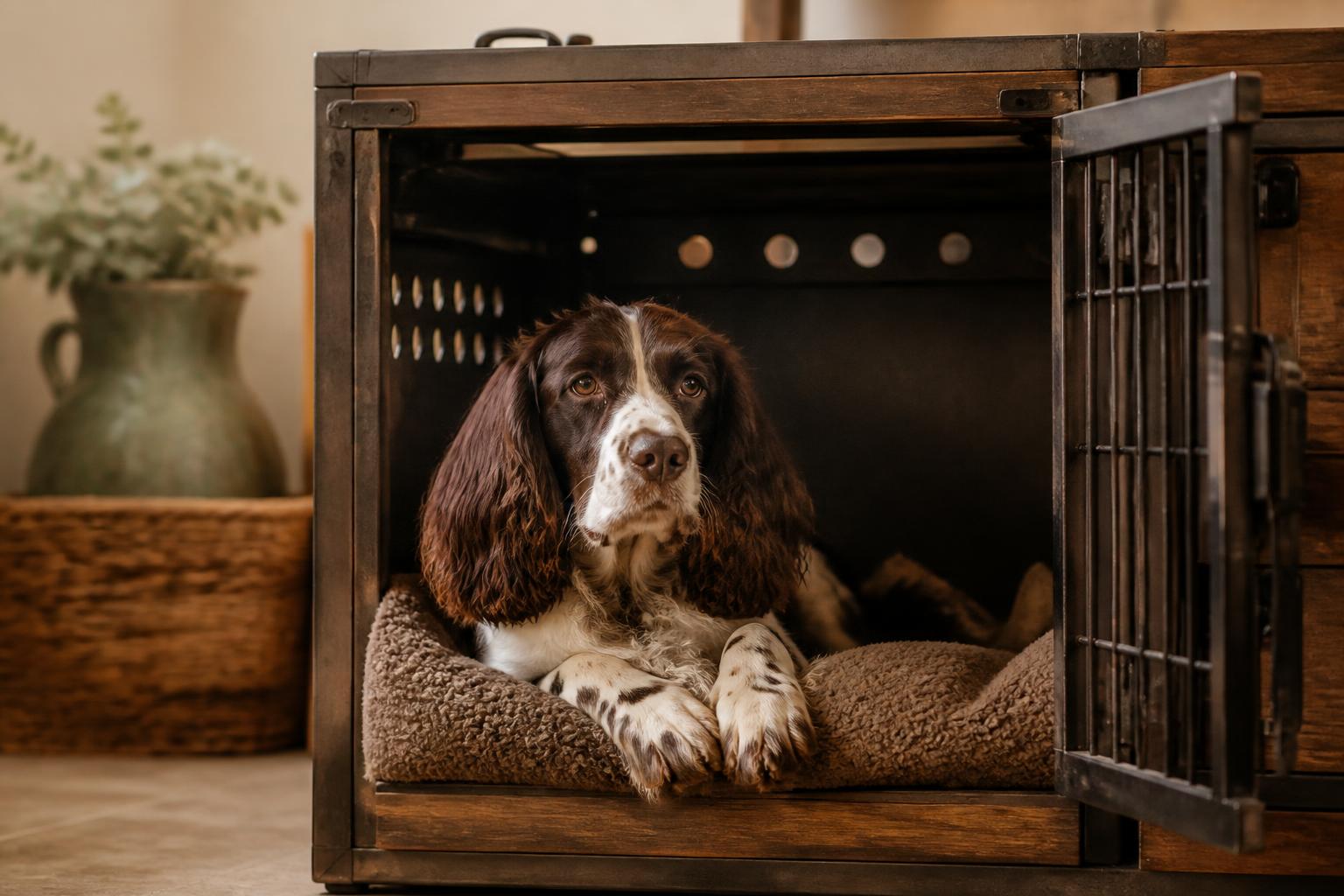
We know the challenge of the “velcro dog” who panics the moment you leave the room, yet by following our cooperative approach to crate enrichment, we can foster true independence. We will show you how to build this essential safe haven, ensuring your Spaniel views rest not as a chore, but as a rewarding job well done.
Making the Crate Their Happy Place with Enrichment
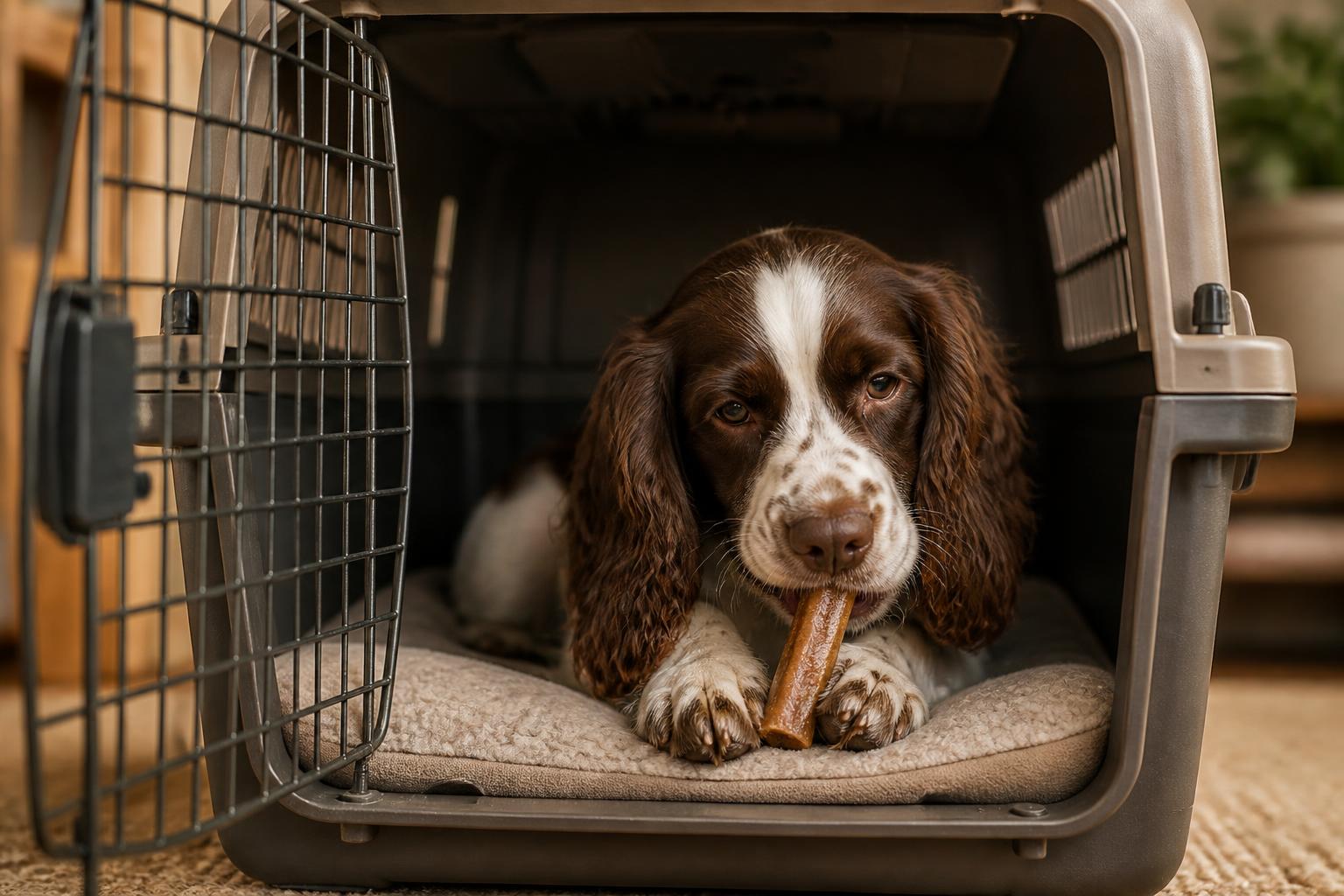
Establishing a positive association with an enclosed space transforms a metal cage into a safe haven where a high-energy Spaniel can finally drop their guard. We understand the hesitation many UK owners feel when first considering a crate, often worrying it feels like “doggie jail.” However, dogs are naturally den animals that instinctively seek out small, protected areas to feel secure when the world becomes overwhelming. By layering the enrichment tools we have already discussed into this specific environment, we provide our Springers and Cockers with a dedicated sanctuary for decompression.
Positive crate training reduces separation anxiety by up to 50%. This statistic highlights why we view the crate not as a tool for restriction, but as a vital component of a Spaniel’s mental health toolkit. When a working-line dog knows they have a space that is entirely their own-free from the “chores” of guarding the front door or following us from room to room-their baseline cortisol levels begin to stabilize. We have found that the secret to this transition lies in ensuring the crate is never used for punishment, but rather as the exclusive venue for their most rewarding activities.
“The goal is to create a conditioned relaxation response where the mere sight of the crate triggers a lowering of the heart rate. We achieve this by pairing the space with high-value, repetitive tasks that engage the parasympathetic nervous system.”
– Senior Trainer, UK Gundog Association
To begin this process, we must ensure the environment is physically supportive of rest. A common mistake we see is owners choosing crates that are either too cramped or excessively large, which fails to provide that “den” feeling of security. We recommend an appropriately sized crate that offers just enough room for your Spaniel to stand up, turn around, and lie down in a natural, flat position. In the UK, crate training is standard practice for gundog puppies, as it provides a consistent “bedroom” whether they are at home, in the back of a vehicle, or in a busy training environment.
We believe in a “nothing for free” approach when it comes to the crate, making it the only place where your Spaniel receives their favorite long-duration enrichment items. High-value treats like a frozen Kong should be reserved specifically for crate time. A frozen Kong in a crate can provide 30-60 minutes of quiet engagement. This repetitive licking acts as a self-soothing mechanism, helping the dog transition from a state of high arousal to a calm, focused mindset. Because the dog is physically contained while working on the chew or lick mat, they are forced to stay still, which naturally encourages the body to relax.
We suggest following a specific checklist to ensure the crate becomes a functional part of your Spaniel’s daily routine:
- Location matters: Place the crate in a quiet corner of a room where we spend time, but away from high-traffic footpaths or draughts.
- Cover the top: Drape a heavy blanket or a fitted crate cover over three sides to mimic a dark, secure burrow.
- Exclusive rewards: Only provide the most enticing enrichment-such as the lick mats or natural chews mentioned earlier-inside the crate.
- Soft bedding: Use Vetbed or similar moisture-wicking materials that stay warm and comfortable even after a rainy walk.
- Open door policy: During the initial training phase, keep the door open so your Spaniel can enter and exit freely, building confidence without feeling trapped.
We often notice that owners struggle with the transition from an active Spaniel to a sleeping one, especially after a stimulating walk. By introducing these enrichment items in the crate, we are setting clear boundaries and establishing a predictable routine. The dog learns that when they enter this space, their “job” changes from hunting and retrieving to foraging and relaxing. This mental shift is a cornerstone of the top-down tiredness philosophy, as it uses the brain to signal to the rest of the body that it is time to power down.
While we focus on making the space inviting, the true value of a conditioned crate safe haven is how it prepares the dog for periods of necessary stillness. It isn’t just about the time spent licking a toy; it is about what happens immediately after the enrichment is finished. Once the Spaniel has exhausted the mental energy required to empty a Kong or work through a chew, they are in the perfect physiological state to drift into a deep, restorative sleep. This leads us to the most vital skill for any high-drive gundog: learning how to actually use that internal “off-switch” when the work is done.
Teaching the ‘Off-Switch’ for Overstimulated Spaniels
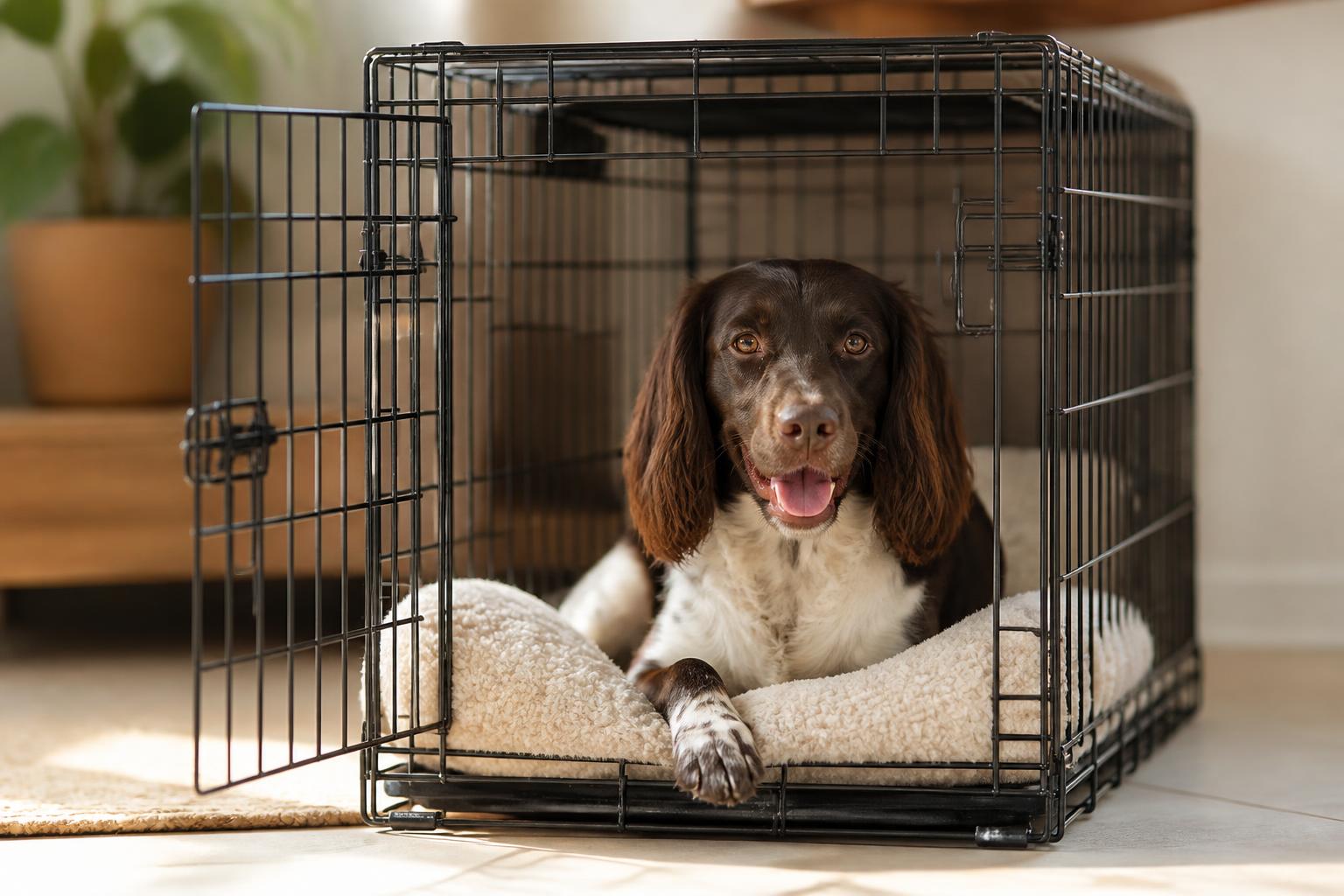
We see the result of a missing off-switch every single day in our training sessions: the frantic “zoomies” at 9:00 PM, the constant pacing, and the Spaniel that seems physically incapable of closing its eyes. The reality is that for a high-drive working dog, relaxation is not a default setting; it is a skill that must be taught through enforced downtime. By integrating the enrichment tools we have discussed into a structured crate routine, we can finally bridge the gap between a dog that is physically exhausted and one that is mentally at peace.
The stakes of failing to implement this structure are remarkably high for the average UK household. Without a designated period for the brain to decompress, Spaniels remain in a state of high physiological arousal, which eventually manifests as chronic anxiety or destructive outbursts. We must treat the crate not as a place of exclusion, but as a biological necessity for recovery. 75% of owners report calmer dogs after implementing enforced rest, proving that the solution to hyperactivity is often less activity, not more.
The Science of the Enforced Nap
We often look to the pioneering work of Dr. Ian Dunbar when explaining why puppy downtime and adult rest are non-negotiable. His research into canine development highlights that overstimulation is a primary driver of behavioral issues. When a Spaniel is awake for too many consecutive hours, their ability to process information degrades, leading to what we commonly call the “witching hour.” Enforced naps of 1-2 hours can significantly reduce ‘witching hour’ behaviour, effectively resetting the dog’s nervous system before they reach a breaking point of over-arousal.
Consistency in routine is the absolute bedrock of success for the Spaniel temperament. These dogs thrive when they can predict the flow of their day, as it removes the “anticipatory anxiety” of wondering what happens next. By scheduling these rest periods at the same time daily-ideally following a mental workout like scent work or a sniffari-we help the dog transition into a state of top-down tiredness. This is where the brain signals to the body that it is safe to sleep, rather than the body being too tired to move while the brain remains “wired.”
Implementing the Crate Enrichment Routine
To make this transition seamless, we must use a specific verbal cue to signal the start of the relaxation cycle. Whether you choose “crate time,” “settle down,” or “in your bed,” the phrase must be paired with a high-value enrichment item to create a positive association. We recommend using a frozen food-stuffed toy or a long-lasting chew as the “entry fee” for the crate. This gives the Spaniel a focused task to complete while they are settling, which naturally lowers their heart rate and prepares them for deep sleep.
| Time Block | Activity Type | Enrichment Tool |
|---|---|---|
| Morning (Post-Walk) | Enforced Rest | Frozen Lick Mat in Crate |
| Mid-Day | Mental Work | Indoor Scent Game |
| Afternoon | Enforced Nap | Stuffed Kong or Natural Chew |
| Evening | Low Arousal | Snuffle Mat for Dinner |
We believe that many owners wait too long to put their dog down for a rest, assuming the dog will sleep when it is tired. However, working-line Spaniels are notorious for “pushing through” fatigue. If you notice your dog becoming “mouthy,” ignoring known commands, or barking at minor household noises, they have likely already passed their threshold. At this point, the crate becomes a tool for preventing overstimulation, providing a quiet space where the dog is protected from the “noise” of a busy household.
“The biggest mistake I see with Spaniel owners is the belief that a tired dog is a happy dog. A dog that is physically exhausted but mentally over-aroused is a dog in distress. We must teach them that doing nothing is a job in itself.”
– Lead Instructor, British Gundog Training Academy
By strictly adhering to this “work-then-rest” cycle, you are effectively installing an internal off-switch. Over time, the sight of the crate and the sound of your verbal cue will trigger a physiological relaxation response before the dog even steps inside. This routine doesn’t just manage energy; it promotes healthy sleep patterns that are vital for long-term cognitive health. A Spaniel that knows how to rest is a dog that is ready to learn when it truly matters.
The transition from a “hyper” dog to a settled companion is rarely about the intensity of the exercise, but the quality of the recovery. When we provide a structured environment where the brain is allowed to switch off, the dog’s overall baseline of anxiety drops. This creates a virtuous cycle: a well-rested Spaniel is more attentive during training, less reactive on walks, and far more enjoyable to live with in a domestic setting. Consistency in routine is key for Spaniels, and the crate is the most effective tool we have to enforce that consistency.
Conclusion
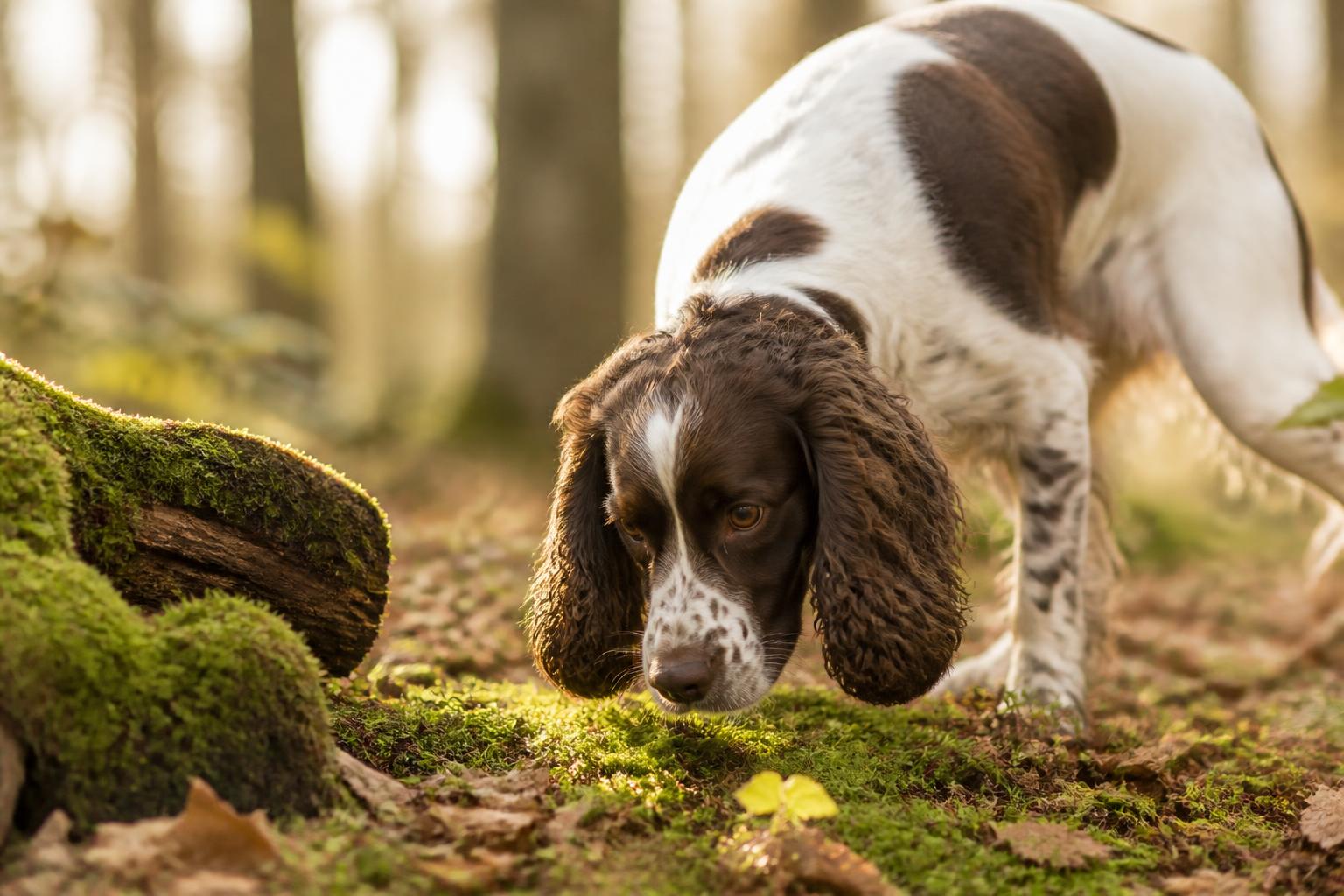
We have learned that a tired Spaniel is not necessarily a calm one. If we continue to rely on endless games of fetch, we are merely building a more athletic, higher-aroused dog with a cortisol level that never has the chance to hit baseline. True contentment for a working-line Cocker or Springer comes from the head, not just the legs. By engaging their gundog instincts through “Top-Down Tiredness,” we stop fighting against their nature and start working with it.
Implementing just three to four enrichment activities daily can reduce destructive behaviours by up to 60%. This shift in approach moves us away from the “more is more” exercise trap and toward a lifestyle where our dogs understand how to regulate their own energy. We know the frustration of a dog that cannot switch off, but through the strategic use of scent work, licking, and foraging, we provide the biological “off-switch” these breeds desperately need. When we enrich their minds, we soothe their anxiety.
- Cortisol management is key: High-intensity chase games spike stress hormones for up to 48 hours; replacing one ball session with a 30-minute “Sniffari” lowers the heart rate by 10-20 beats per minute.
- Instinctual outlets prevent destruction: Providing safe, long-lasting chews like Yak cheese or antlers satisfies the urge to chew, which releases serotonin and reduces separation-related pacing.
- Mealtimes are missed opportunities: Using snuffle mats or puzzle feeders transforms a 30-second gulp into a 20-minute mental workout, burning more calories through cognitive effort than a standard walk.
- Crates are for decompression: A well-conditioned crate, paired with a frozen Kong, creates a positive safe haven that teaches a Spaniel to settle and prevents the “witching hour” caused by overstimulation.
We suggest you start this afternoon by changing how you deliver your Spaniel’s next meal. Put the plastic bowl in the cupboard and scatter their dry biscuit treats or kibble across a large towel, then scrunch it up to create a simple DIY foraging game. Watch how hard their nose works and notice the immediate “sigh” of relaxation when they finish. This small change is the first step toward a more peaceful home.
A settled Spaniel is a happy Spaniel, and a happy owner.
Check out our 10 Best Spaniel Toys for Mental Stimulation & Boredom (Tried & Tested) article.